A north star metric (NSM) is a primary indicator of the value a product delivers and the progress it makes toward its strategic objective. It aligns teams around a measurable outcome and helps determine which architecture modernization efforts matter most. section 3.0 section 3.3
A useful NSM should:
- Express customer value while representing product vision and strategy. section 3.3 section 3.3.2
- Remain quantifiable, actionable, simple enough for everyone to understand, and distinct from a vanity metric. section 3.3.1 section 3.3.2
- Connect to input metrics that teams can influence through research, design, development, refactoring, prototyping, and testing. section 3.3.2
- Avoid incentives that improve the number by damaging customer value, such as removing lower-value customers to raise average revenue per customer. section 3.3.1
Danske PSD2 initiative
Teams debated whether the initiative was primarily a transaction game or a productivity game. They chose productivity and defined the NSM as “average number of changes to the budget made by advisors or customers per case after credit model assessment.” Complementary inputs addressed data, breadth, accuracy, and efficiency; their dependencies formed a flywheel rather than a flat list of goals. section 3.3.3
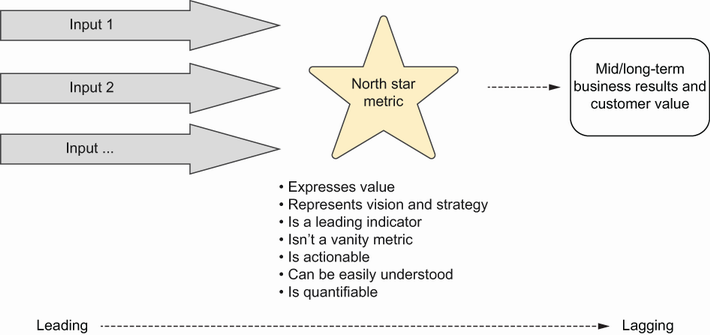
Use the framework visualization to relate work-level input metrics to the NSM, customer value, and mid- or long-term business results. section 3.3.2
Choose the metric by studying the value loyal customers receive, quantifying that value, and testing whether the resulting measure encourages the intended behavior. NSMs may differ by industry, product type, evolution stage, and organizational level; product portfolios can contain multiple aligned NSMs. section 3.3.1 section 6.5

