An observer is a facilitator stance centered on noticing participant behavior, group interaction, and session dynamics rather than primarily directing the activity. This stance provides the information needed to adopt other stances, such as coordinator, coach, enabler, counselor, or task organizer. section 5.1
Observation becomes a practical discipline: notice interaction patterns, emotional responses, participation gaps, and shifts in group energy. These observations help a facilitator support collaboration while preserving the group’s responsibility for its outcome. section 5.1.2 section 5.9
During a collaborative modeling session, look for signals such as:
- Someone speaks very little and later re-enters the conversation. section 8.3
- One participant raises their voice, dominates discussion, and leaves the room silent. section 8.3
- Your own emotional reaction begins influencing how you interpret the group’s dynamics. section 8.3
Using observation to support resolution
In an EventStorming session, the facilitator notices that a participant’s raised voice is followed by silence. Rather than immediately directing the discussion, the facilitator treats the pattern as information and uses it to decide how to help people collaborate and participate in their own way. section 8.3
Figure 5.1 The facilitator takes on different stances. The observer stance takes a central place, which provides a facilitator with important information to take on other stances.
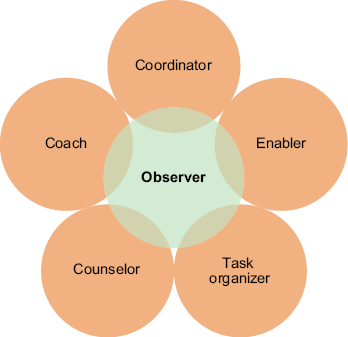
Figure 5.1 places the observer stance at the center of the facilitator’s other stances, emphasizing observation as the source of information for choosing how to intervene. section 5.1
