A facilitator guides a collaborative activity by making its flow easier for participants. The role centers on communication, participation, and shared understanding, while the group—not the facilitator—remains responsible for decisions and outcomes. In collaborative software design, facilitation helps stakeholders and development teams surface assumptions, work through tensions, and make sustainable design decisions. section 1.0 section 5.1
Facilitator is a role rather than a job title. A team lead, architect, engineer, tester, product owner, researcher, or stakeholder can take it on. Dedicated facilitators are often valuable because combining participation with process guidance can divide attention, create conflicts of interest, and weaken focus on group dynamics. section 5.1 section 5.9
Effective facilitation combines several stances and skills:
- Observe people, interactions, verbal statements, body language, and patterns before and during a session. section 5.1 section 5.1.1
- Coordinate, coach, enable, counsel, or organize tasks as the group’s needs change; observation supplies information for these shifts. section 5.1
- Stay neutral about content and outcomes, focusing instead on a fair process that lets every perspective be heard. section 5.4 section 5.4.1
- Listen actively, ask objective questions, return observations and summaries, and hold space for ideas, concerns, and emotions. section 5.4.2 section 5.9
- Notice strong and weak signals, then connect repeated signals into patterns rather than treating one occurrence as conclusive. section 5.4.2
Handling a difficult redesign conversation
Before a redesign session, separate interviews can reveal frustration that participants may not voice in a group. Conflicting words and body language are useful observations, not proof of intent. During a sensitive conversation—such as disagreement over a standard product versus customized solutions—the facilitator protects a safe space, invites all perspectives, and guides listening so disagreement does not become an unproductive conflict. section 5.1.1 section 5.4.1
Social dynamics can block a group’s collective knowledge: rank, cognitive bias, conflict, resistance, and polarities may remain hidden until they disrupt progress. A facilitator makes these dynamics visible without forcing the group to confront them; the group decides whether and how to address what emerges. Facilitator neutrality also matters because an urge to solve the problem can reinforce the very dynamics being observed. section 1.3.3 section 5.9
Sensemaking is especially useful when a group needs to discuss conflict, negative emotions, or strained relationships. The facilitator has no stake in the content, but guides the route toward a conversation: collect perspectives through an exercise, help participants see the pattern, then support mutual understanding with more listening than talking. section 5.4 section 5.4.2
For a check-in or check-out, the facilitator can use a simple flow:
- Prepare a question by sensing topics important to the group, then begin by answering with appropriate vulnerability. section 5.4.3 section 4.4.2
- Use popcorn order and uninterrupted sharing; everyone contributes or explicitly passes. section 4.4.2
- Listen for themes, summarize clusters and notable examples, ask what was missed, invite reactions, and carry relevant feedback into the session design. section 5.4.3 section 4.4.2
Preparation includes learning why the session is happening now and looking for possible conflicts, disagreements, polarities, tension, hierarchy, or hidden agendas. Plans should remain adjustable: an exercise may expose further issues and require a follow-up exercise or conversation. Keep prior sensemaking outcomes when they may help a later group reflect. section 5.4.4
Remote facilitation uses the same core skills but changes what can be observed. Agree on practical expectations such as cameras being on when possible, keep both people and the digital whiteboard visible, and attend to limited nonverbal cues such as posture, gaze, distraction, nodding, and gestures. section 5.5.2 section 5.9
Figure 5.1 The facilitator takes on different stances. The observer stance takes a central place, which provides a facilitator with important information to take on other stances.
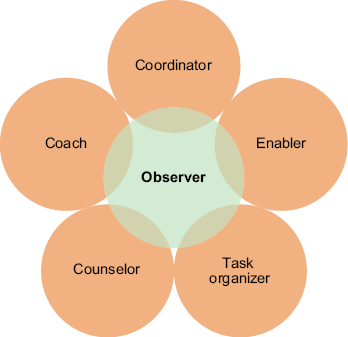
Compare the observer, coordinator, coach, enabler, counselor, and task-organizer stances, with observation at the center. section 5.1
