A safe space is an interaction environment where people can put forward genuine views, including views that differ from management or the majority, without fearing hostility, judgment, or pressure to perform socially acceptable agreement. It matters most when a group must make sense of sensitive work: conflicts, disagreements, negative emotions, polarities, and decisions that affect people’s roles or interests. section 5.4.1 section 5.4
Creating one is a facilitation responsibility, not a logistical task. The facilitator is concerned with the process rather than the decision’s content or preferred outcome. That distance helps the group examine difficult matters without facilitation becoming persuasion. Observation, listening, questions, and holding space make it possible to bring the group’s full wisdom—including dissenting perspectives—into the conversation. section 5.4 section 5.4.1
Use these practices to make participation safer while keeping the group moving:
- Address patterns in the group rather than singling out an individual. Publicly spotlighting someone who is unprepared can prompt a safe answer instead of an honest one. section 8.3.2
- Do not assign turns during check-ins when the aim is to hear genuine thoughts. Let people choose when they are ready to contribute. section 8.3.2
- Open with a check-in that combines personal awareness with session-focused questions, such as energy level, an important goal, unspoken concerns, or what participants know and wonder. section 4.4.1
- Close with a check-out: ask how people are leaving, what remains unsaid, and whether agreements are needed. Keep it a sharing format rather than letting it become a debate. section 4.4.1
- When a large modeling group needs both speed and completeness, split into groups but reconvene regularly. Ask who can somewhat relate to an emerging view so alternative perspectives can re-enter the shared model. section 3.2.2
A disputed design boundary
A collaborative modeling session reaches a boundary decision that affects several teams. Some participants support a standard product; others need customized solutions. Because preferences can feel judged, the facilitator does not argue for a result or force quiet participants to speak. Instead, they create room for all perspectives, periodically reconvene subgroups, and ask who can somewhat relate to the proposed view. The group can then weigh minority wisdom alongside progress rather than treating silence as agreement. section 5.4.1 section 3.2.2
Safety does not mean avoiding conflict or immediately solving it. It lets conflict become visible without reducing people to opponents. After presenting a climate report, pause and observe rather than drawing conclusions. Wait for the group to recognize the report, or ask whether it resonates, before proposing a solution. This preserves the group’s ownership of both the problem and its response. section 8.3.2
Figure 4.14 Example check-out we used at BigScreen. Similar to the check-in, always tailor the check-out format and questions for each session. This ensures participants leave feeling comfortable and connected to the session’s outcomes.
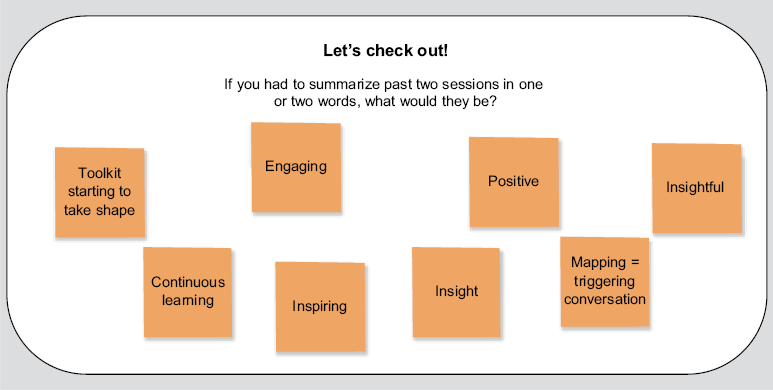
Use a tailored check-out to surface unfinished concerns, assess how participants experienced the session, and help them leave connected to its outcomes. section 4.4.1
