liveBook · Manning

Clean language

As explained in Collaborative Software Design: How to facilitate domain modeling decisions

Clean language is a therapeutic communication technique that uses simple, open-ended questions based on a speaker’s exact words while avoiding the questioner’s assumptions, suggestions, metaphors, and interpretations.

Clean language is a therapeutic communication technique for verifying what someone means by using their words without adding assumptions, suggestions, metaphors, or interpretations. section 5.3.2

Use clean language to:

  • Check whether you understood a word or concept rather than silently filling in its meaning. section 5.3.2
  • Ask open-ended questions that help people clarify their own thoughts, ideas, opinions, and beliefs. section 5.3.2
  • Keep disagreements focused on expressed meaning instead of treating assumptions about another person’s intentions as truth. section 5.3.2

Clarifying a disagreement

When two developers disagree about a redesign, ask what each person means by the important terms and why they consider their solution good before evaluating the proposals. section 5.3.2

Figure 5.7 The six categories of Socratic questioning with generic example questions that you can adapt during a collaborative modeling session
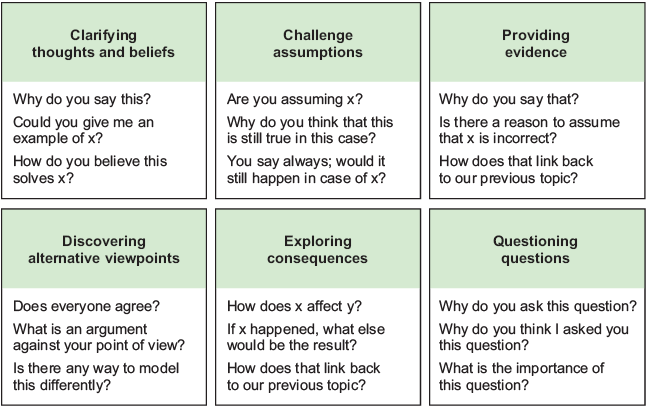
Use the six Socratic-questioning categories as a prompt set for adapting clarifying questions during collaborative modeling. section 5.3.2

How Collaborative Software Design: How to facilitate domain modeling decisions covers it

How deep it goes
Defines meaning verification and questioning, then applies them to assumptions and interpersonal conflict.
Examples
Uses word and concept verification, summarizing, open-ended questions, and a redesign disagreement between two developers.
What it assumes
Assumes active listening and clear communication while developing shared understanding through questioning.
What you can do after
Practice/perform it by verifying meanings and asking questions that expose assumptions during dialogue.
How it connects
Connects active listening, clear communication, Socratic questioning, shared understanding, and collaborative modeling.

Related concepts

This explainer was generated by Manning's knowledge graph from the text of Collaborative Software Design: How to facilitate domain modeling decisions. The section links point to the parts of the book it draws on.