Socratic questioning creates a thoughtful dialogue that helps people clarify, examine, and improve their own thoughts, ideas, opinions, and beliefs. In collaborative modeling, it helps stakeholders build a deep, shared understanding without the facilitator supplying conclusions. section 5.3.2
Use questions to make reasoning and communication more explicit:
- Clarify thoughts and beliefs by asking what makes someone consider a solution good, such as: “Why do you think your solution for the redesign is a good one?” section 5.3.2
- Challenge assumptions by making unconscious beliefs visible, especially when people treat assumptions about another person’s intentions as truth. section 5.3.2
- Request concrete examples when discussion becomes vague: “Could you provide further insight by offering an example of X?” section 5.6
- Keep inquiry open and neutral by asking, “Who can somewhat relate to what’s been said?” or “Who sees it differently?” section 5.6
Turning conflict into inquiry
When Rose and Jack disagree about a redesign and assume the other person refuses to understand, ask each developer to explain why their solution is good. Then probe the assumptions behind their interpretations instead of choosing a side. The questions clarify both the facilitator’s understanding and the developers’ own reasoning. section 5.3.2
Figure 5.7 The six categories of Socratic questioning with generic example questions that you can adapt during a collaborative modeling session
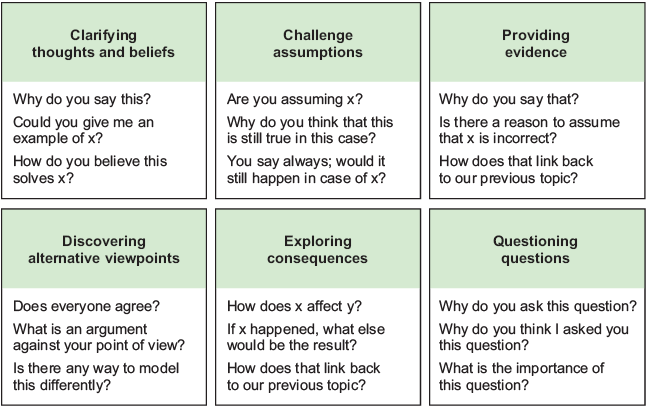
Use the six-category question guide to adapt Socratic prompts during collaborative modeling sessions. section 5.3.2
