When a certificate is compromised, clients need a way to learn that it should no longer be trusted. OCSP stapling moves the status lookup from each client to the website: the website asks the certificate authority (CA) for a signed certificate-status response and attaches it during the TLS handshake. section 9.3
The basic flow is:
- The website queries the CA for the status of its certificate. section 9.3
- The CA returns a signed response indicating the certificate's status. section 9.3
- The website staples that response to its certificate during the TLS handshake. section 9.3
This approach addresses weaknesses in OCSP: CA services must otherwise remain highly available, requests reveal browsing information to CAs, and browsers may ignore timed-out requests to avoid disrupting users. Revocation remains defense in depth rather than an everyday feature. section 9.3
Figure 9.9 Certificate revocation on the web has had three popular solutions: Certificate Revocation Lists (CRLs), Online Certificate Status Protocol (OCSP), and OCSP stapling.
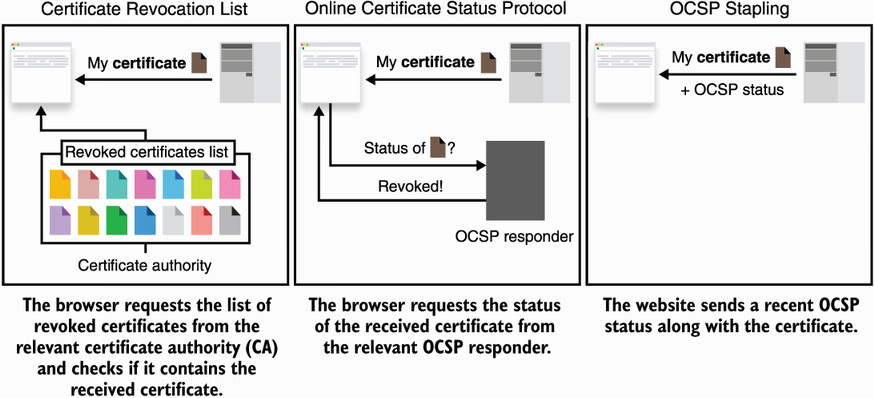
Compare certificate revocation through CRLs, OCSP, and OCSP stapling. section 9.3
