A certificate can become dangerous after its private key is compromised. OCSP lets a browser or other client query a certificate authority through a simple web interface to learn whether the certificate has been revoked. section 9.3
OCSP improves on certificate revocation lists, but introduces practical tradeoffs:
- It avoids downloading and repeatedly checking potentially large revocation lists. section 9.3
- It requires certificate authorities to operate highly available status services. section 9.3
- It can reveal web traffic information to the authority, while timeouts may be ignored to preserve the user experience. section 9.3
OCSP stapling
A website can query the authority for a signed certificate-status response and attach, or “staple,” that response during the TLS handshake, reducing direct client queries to the authority. section 9.3
Figure 9.9 Certificate revocation on the web has had three popular solutions: Certificate Revocation Lists (CRLs), Online Certificate Status Protocol (OCSP), and OCSP stapling.
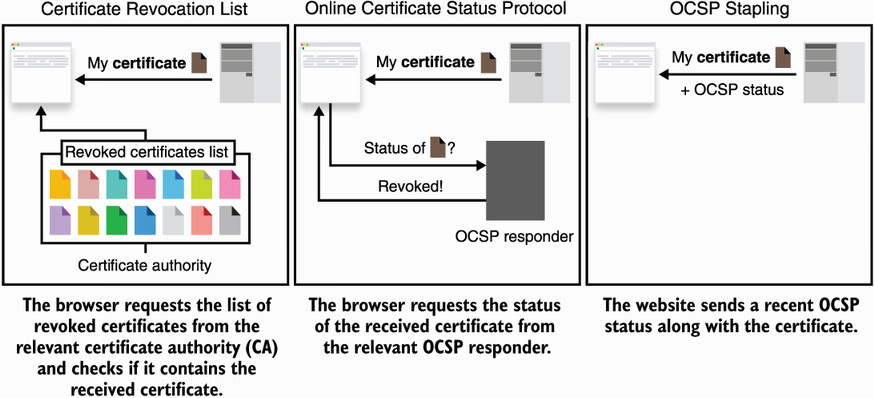
Compare certificate revocation lists, direct OCSP queries, and OCSP stapling as three approaches to checking certificate status. section 9.3
