An octave is the distance between one level of musical pitch and the next. Moving up one octave doubles a sound’s frequency: A4 is 440 hertz, while A5 is 880 hertz. section 13.1.1
Each octave contains 12 semitones, from C through B. The same note name reappears after 12 semitones at a higher or lower octave, while a pitch number identifies both the octave and semitone. section 13.1.1 section 13.6
Reading octave and pitch
The number in C4 indicates octave 4. C4 has pitch number 60, whereas F3 has pitch number 53. These pitch numbers encode the note’s octave level and semitone for musical data. section 13.1.1
Figure 13.1 The relationship between musical notes, octaves, and pitches (also known as note numbers). The first column displays the 11 octaves (ranging from –1 to 9), representing different levels of musical sound. Each octave is subdivided into 12 semitones, which are listed in the top row: C, C#, D, D#, ..., B. Within each octave, each note is assigned a specific pitch number, ranging from 0 to 127, as indicated in the figure.
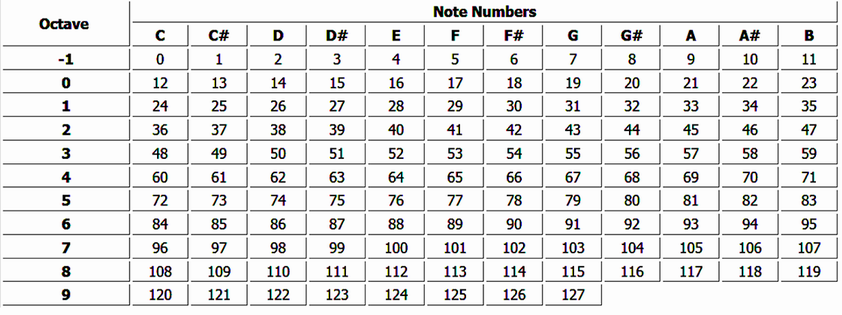
Use the octave-and-pitch diagram to compare 11 octave levels, their 12 semitones, and pitch numbers from 0 to 127. section 13.1.1

