liveBook · Manning

Offline loop

As explained in Self-Improving Agents

An agent-improvement cycle that evaluates proposed changes and applies them after a deployment review.

An offline loop improves an agent between deployments: it evaluates proposed changes and routes a candidate through a deployment gate before applying it. Its four steps are act, signal, search, and apply, then repeat. section 1.2.3 section 1.5

A prompt-improvement loop puts those steps into practice:

  • Act with a baseline RAG agent prompt; score its output with an LLM-as-Judge signal. section 2.0
  • Search for better prompt variants with Self-Supervised Prompt Optimization (SPO), then evaluate candidates. section 2.0
  • Inspect the candidates and promote a winner through the deploy gate; the running agent keeps its original prompt until promotion. section 2.5
Figure 1.7 shows a comparison between the offline and online self-improvement loop where the significant difference is the deployment gate that manages deployments of improved variants
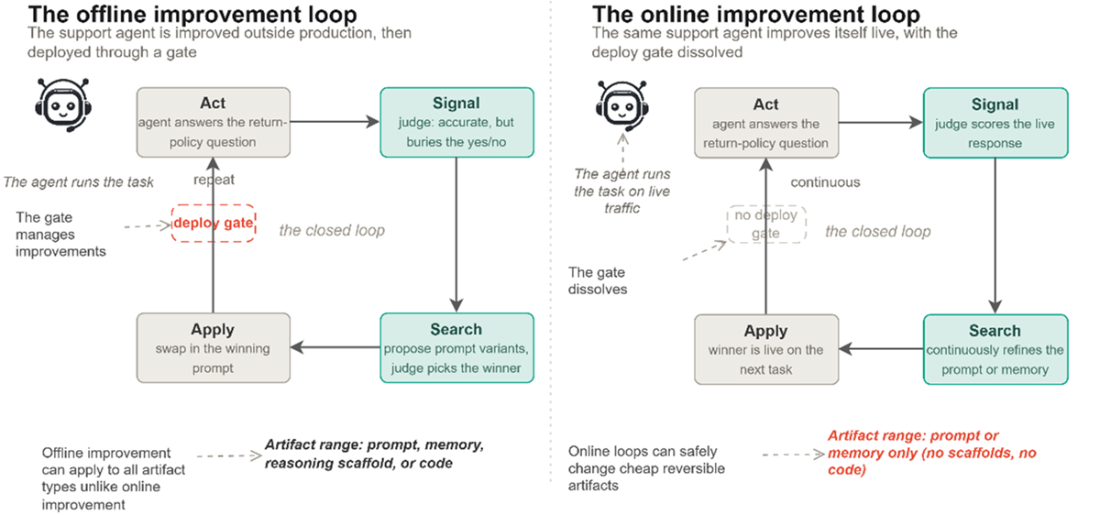
Compare offline and online loops by their deployment gate, the key difference between the two cadences. section 1.2.3
How Self-Improving Agents covers it

How deep it goes
Completes an act–signal–search–apply cycle and demonstrates candidate evaluation, archive inspection, and manual promotion.
Examples
Uses a RAG prompt, LLM-as-Judge scoring, and SPO variants, then promotes the strongest candidate after three rounds.
What it assumes
Introduces agent building with Helix before composing the improvement loop block by block.
What you can do after
Build and run an offline prompt-improvement loop with Helix, inspect its candidates, and promote a selected winner.
How it connects
Connects self-improvement with deployment review, signal design, search methods, LLM-as-Judge, and Self-Supervised Prompt Optimization.

Related concepts

This explainer was generated by Manning's knowledge graph from the text of Self-Improving Agents. The section links point to the parts of the book it draws on.