Self-hosting means operating computing infrastructure in your own facilities instead of relying entirely on a cloud provider. You control the physical premises and hardware, but that control comes with responsibility. section 1.5.1 section 6.2.1
Self-hosting can make sense when:
- You need precise control over where data is stored, such as to meet country-specific legislation. section 1.5.1
- Your hardware and software must meet company-specific security requirements. section 1.5.1
- You already have infrastructure that makes hosting new applications inexpensive. section 1.5.1
The trade-off is that you manage the infrastructure yourself: patching servers and defending against threats such as DDoS attacks are your responsibility. Scaling can also mean buying and installing hardware that may sit idle between peaks. Existing needs and investments can justify that work, but new on-premises setups are growing more slowly as cloud use spreads. section 6.2.1 section 1.3.1
Connect an office to Azure
An organization can keep a network in its own data center while connecting it to an Azure network with a VPN Gateway. This site-to-site setup combines on-premises infrastructure with cloud resources rather than moving everything to one place. section 4.4.2 section 1.8
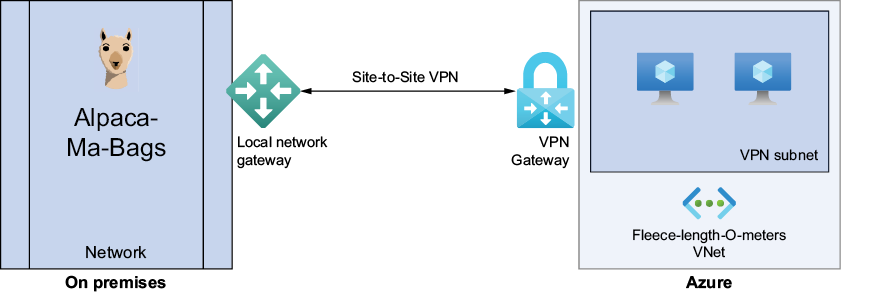
The diagram shows a site-to-site VPN connection between an on-premises network and Azure. section 4.4.2




