The one-or-more quantifier, written +, requires the preceding character class, expression, or group to match at least once. In Python regular expressions, adding + to a consonant class changes a match from the first consonant to a leading consonant sequence: chair produces ch. section 14.1.2
Match repeated characters
>>> re.match(f'[{consonants}]+', 'chair') <re.Match object; span=(0, 2), match='ch'> >>> re.search(r'\d+', 'abc123!') <re.Match object; span=(3, 6), match='123'> >>> re.search(r'\w+', 'abc123!') <re.Match object; span=(0, 6), match='abc123'> Because + requires a match, the consonant pattern returns None for apple. Combining + with capture groups can split a word into repeated leading consonants and the remaining text, while combining it with re.split() groups adjacent non-word characters such as ', ' together. section 14.1.2 section 14.1.3 section 15.1.2 section 15.1.4
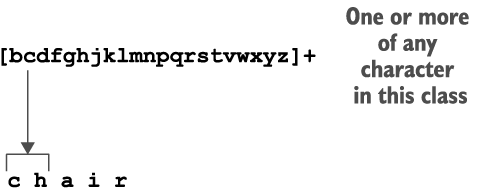
Use the figure to compare a character class without + against the one-or-more form. section 14.1.2

