An online store holds feature values for low-latency retrieval during real-time inference. In a Feast architecture, a feature pipeline writes datasets to an offline store such as MinIO, then Feast periodically materializes those features into an online database such as Redis. The feature registry records definitions, entities, names, and store locations, while the Feast Python SDK retrieves features for training or inference. section 4.2
A production online-store setup connects several operational pieces:
- Use the offline store for training data and the online store for inference-time retrieval. section 4.2
- Configure Redis, DynamoDB, or Google Cloud Datastore according to latency and system requirements. section 4.2
- Register entities and feature views before materializing their offline data into the online store. section 4.2.1
- Treat materialization as the synchronization step that makes offline features available for real-time prediction. section 4.2
Feast with Redis and MinIO
A feature_store.yaml configuration can use an S3-backed registry and file-based offline store in MinIO, with Redis as the online store: registry: s3://feature-registry/registry_local.db; offline_store: type: file; online_store: type: redis; connection_string: localhost:6379. After making MinIO and Redis reachable, running feast apply registers the entity and feature views and deploys their online infrastructure. section 4.2.1
Figure 4.10 Feast feature store design involves a feature pipeline populating the offline store and periodically Feast materializes the offline features to the online store. The feature registry holds feature definitions along with online and offline store information. The Feast SDK provides methods to retrieve features from online and offline stores, which can be used for training and inference purposes.
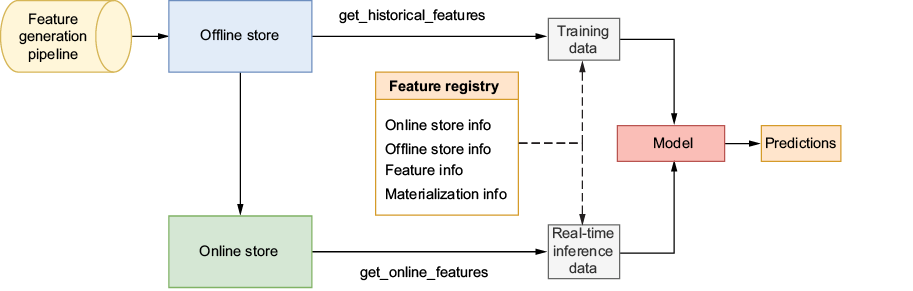
Trace how a feature pipeline populates the offline store, Feast materializes features into the online store, and the registry and SDK connect both retrieval paths. section 4.2
