ONNX (Open Neural Network Exchange) is a universal, cross-platform format for trained deep-learning models. It provides an intermediate representation when a model must move between framework ecosystems instead of being rebuilt or locked into a native format. section 4.2.2 section 6.4.2
A practical workflow is to export a PyTorch-trained model to ONNX, convert it for TensorFlow use when needed, or run it through ONNXRuntime to optimize inference for the target hardware. This matters when reusing pretrained models from frameworks such as MXNet, PyTorch, or TensorFlow in a fraud-detection deployment. section 4.2.2 section 4.4
Text detection on receipt images
An expert text-detection model supplied in ONNX format can be loaded as an ONNX session and run on a receipt image. Its pixel-level output is converted into text bounding boxes, which can supply auxiliary labels for a document-forgery detection task. section 6.4.2
Figure 4.11 ONNX as an intermediate representation to convert trained deep learning models from one framework (left) to another (right).
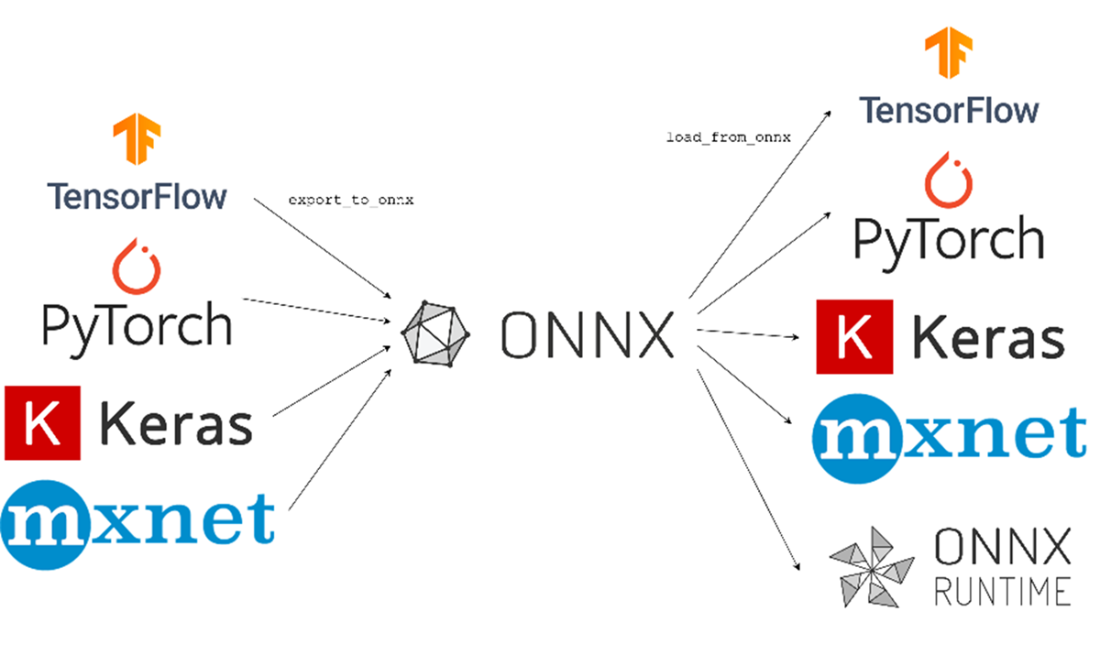
The diagram shows ONNX acting as the intermediate model representation between deep-learning frameworks. section 4.2.2