ONNX provides a common model representation between training frameworks and production inference systems. It helps teams preserve research flexibility while deploying models across platforms, though direct framework serving may be more flexible and highly custom engines may be faster. section 15.3.1
Use ONNX as a practical deployment layer when you need to:
- Convert trained models from supported training frameworks into a static graph representation. section 10.6.2 section 15.3.1
- Run models with ONNX Runtime across platforms and hardware backends. section 15.3.1
- Connect optimized backends such as OpenVINO for CPUs or TensorRT for CUDA inference. section 15.3.1
- Pair model files with inference parameters, preprocessing choices, and reproducible training artifacts. section 10.6.2
Two-encoder training pipeline
A multimodal training pipeline can export both a text encoder and an image encoder to ONNX, save them with prompt-generation, image-preprocessing, and distance-function parameters, and record training metrics alongside the artifacts. section 10.6.2
Figure 15.3 A wide spectrum of tools with their focus on either research or production serving goals
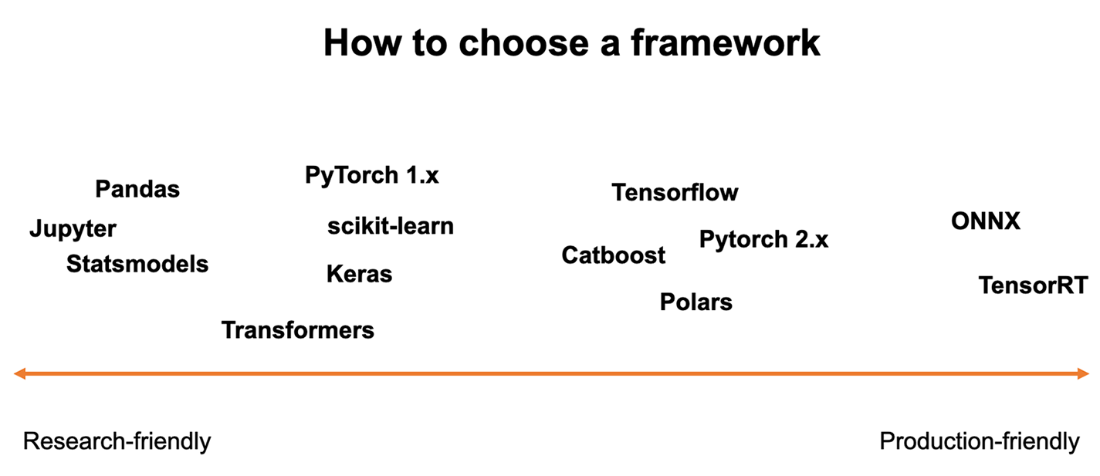
Use the framework spectrum to compare research-oriented tools, universal formats, runtimes, and production-serving systems before choosing an inference path. section 15.3.1






