OpenAI Gym is an open-source toolkit for exploring and evaluating reinforcement-learning and other reward-driven decision models through a large collection of problem environments. It supplies a practical place to run an agent against tasks ranging from simple control problems to Atari-style games, compare approaches, and inspect how rewards shape behavior. section 11.1.1 section 11.6
A Gym environment is used as an interaction loop: create it, reset it to obtain a state, choose an action, call step, receive a new state and reward, and stop when the episode ends. Its action space and observation space define what an agent can do and what information it receives. section 11.1.1 section 11.2
FrozenLake with a Q-table
Create FrozenLake-v0 with gym.make, read the number of actions and states, then allocate a zero-filled Q-table. During 20,000 episodes, choose either the best known action or a sampled action, update the table from each reward and next state, decay exploration, and finally run greedy episodes. The 4-by-4 lake rewards reaching the bottom-right goal and ends negatively when the agent falls through a hole. section 11.1.1
Gym environments provide progressively different control and decision problems:
- MountainCar requires rocking a car in a valley to gain enough momentum to reach a hilltop. section 11.2
- Pendulum requires applying force at suitable positions to keep a rocking arm upright. section 11.2
- CartPole requires balancing a pole while controlling a moving cart’s position and velocity. section 11.2
- LunarLander requires landing on a flat surface slowly enough to avoid failure. section 11.2
Notebook-based exploration can render environments even on a server runtime. A virtual display supports frame rendering; captured RGB frames can be assembled into video while random actions establish a simple baseline. Switch among available environment names, inspect their spaces, and add another environment to test a randomly acting agent. section 11.2 section 11.2.1
Gym supports comparisons among reinforcement-learning approaches rather than prescribing one agent. Q-learning uses a state-action lookup table; deep Q-learning replaces that table or policy with deep learning; NEAT can also act in sample environments through evolutionary learning. More complex tasks such as LunarLander make these contrasts useful. section 11.2 section 11.6
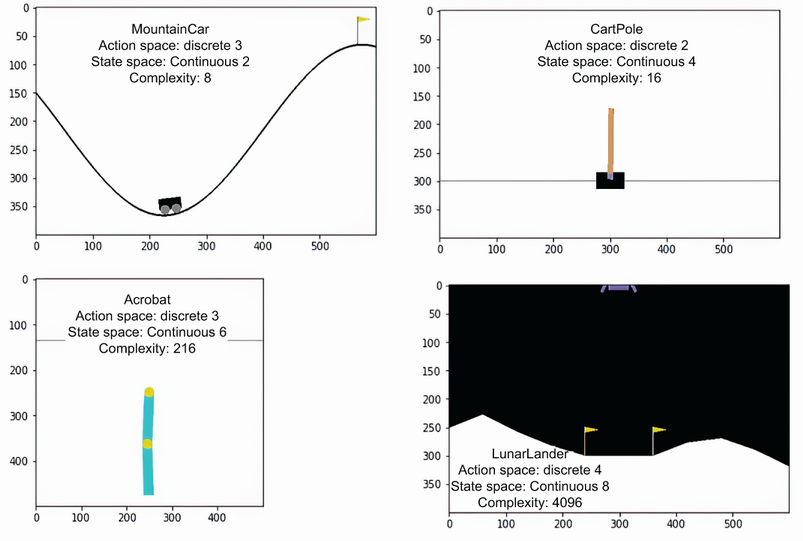
Compare the available environments as candidate benchmarks before selecting one for an agent experiment. section 11.2


