Operational burden is the additional effort, resources, and complexity required to deploy, operate, maintain, monitor, scale, and troubleshoot a data platform. It is an architectural concern alongside performance, security, and integrity because it affects agility, support capacity, compliance, and long-term cost. section 5.1.4 section 7.2.5
Assess operational burden across several related dimensions:
- Total cost of ownership includes storage capacity, data transfer, replication, access patterns, archival, hardware, power, cooling, staffing, and maintenance. section 5.1.4
- Management effort increases with manual tuning, scaling, troubleshooting, high-availability requirements, multiregion deployment, and vendor-specific expertise. section 5.1.4 section 7.2.5
- Automation, observability, self-service capabilities, structured logs, metrics, alerting, and automated recovery reduce support effort and time to resolution. section 5.1.4 section 7.2.5
- Interoperability and mature documentation reduce custom integration work, lock-in, onboarding time, and dependence on in-house specialists. section 5.1.4 section 7.2.5
- Managed services usually reduce maintenance, while self-managed systems can reduce licensing costs but require more engineering effort; both may create different cost or lock-in tradeoffs. section 7.2.5 section 6.5.5
Operational choices by organizational context
A startup with limited DevOps capacity may favor managed Wasabi or containerized MinIO for simpler deployment and predictable operations. An enterprise consolidating workloads may accept higher-cost Dell ECS, NetApp StorageGRID, or Everpure for multitenancy, centralized monitoring, policy enforcement, and support controls. A routine ingestion workload may use Fivetran or Airbyte to reduce manual schema management, while accepting less flexibility for advanced transformations. section 5.5.4 section 6.5.5
Figure 5.4 Factors to consider when estimating the storage system’s cost
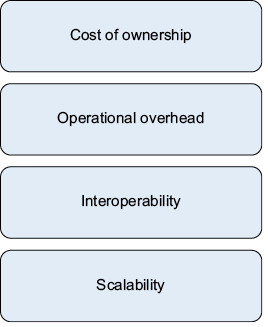
Use the cost-factor figure to compare financial and operational inputs before selecting a storage layer. section 5.1.4
