An opportunity space is the set of customer needs, business possibilities, and strategic openings where AI could address problems or create value. Strong opportunities begin with an existing or latent need, not excitement about AI alone. They may also arise from company data, specialist expertise, or long-term strategy. section 1.3.1 section 2.0
Shape an opportunity by testing four practical questions:
- What customer task, pain point, desire, or latent need deserves attention? section 1.3.1
- What value would AI create beyond a traditional solution, such as flexible access, task automation, or improved human output? section 1.3.1
- Can the organization support the investment in infrastructure, development, skills, and technical feasibility? section 1.3.1 section 2.0
- Does the initiative fit company strategy, goals, skills, and the balance between quick wins and long-term advantage? section 2.0
From fixed dashboards to flexible access
A fixed dashboard exposes only designer-selected data. Conversational access lets users work with relevant points across the broader dataset, creating tangible user value and potentially supporting higher pricing and adoption. By contrast, an AI chatbot without a clear use case can frustrate users. section 1.3.1 section 2.0
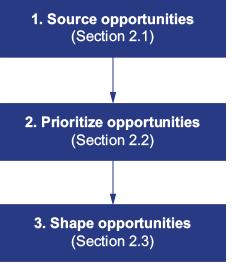
Use the opportunity-discovery process to move from sourcing possibilities through evaluation, prioritization, and shaping high-impact initiatives. section 2.0
