In Bayesian optimization, the optimal value is f* = f(x*): the objective-function value attained at the optimizer. Under a Gaussian-process belief, f* is itself a random variable. section 6.2.1
Although the optimizer x* can be a complicated, non-Gaussian vector, f* is always a one-dimensional real value. Sampling its distribution therefore makes entropy-based search easier to approximate. section 6.2.1
Incumbent bound
If the best observed objective value is 1.6, the distribution of f* is truncated around 1.6 because the optimum cannot be worse than the incumbent. section 6.2.1
Figure 6.11 The GP belief (top left), the distribution of the function optimizer x* (bottom), and the distribution of the optimal value f* (right). The distribution of the optimal value is always one-dimensional and, therefore, easier to work with than that of the optimizer.
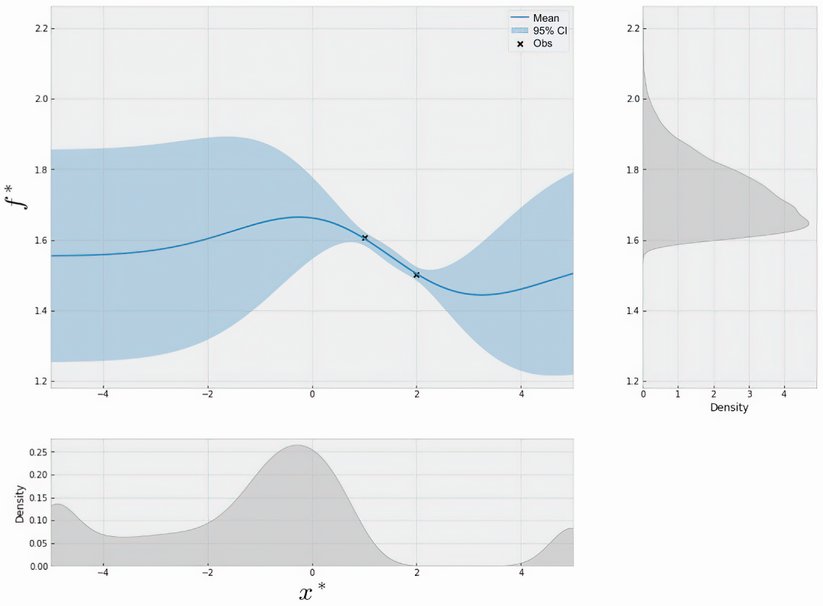
Compare the complicated distribution of the optimizer with the simpler, always one-dimensional distribution of the optimal value. section 6.2.1
