In black-box optimization, the optimizer is the input location where the objective reaches its highest value. If x* is optimal, then f* = f(x*) ≥ f(x) for every x in the domain D. section 6.2.1
A Gaussian-process belief about the objective induces a probability distribution over x*. That distribution may be multimodal, place mass at domain endpoints, and be difficult to model as dimensionality increases. section 6.2.1
Useful consequences of treating the optimizer as a random variable include:
- Sampling functions from the Gaussian process and recording each sampled maximum provides a simple estimate of the optimizer distribution. section 6.2.1
- Entropy-search policies target uncertainty about the optimizer, while the optimal value f* offers a simpler one-dimensional alternative. section 6.2.1
Figure 6.10 GP belief (top) and the distribution of the function optimizer x* (bottom). The distribution of the optimizer is non-Gaussian and fairly complicated, posing a challenge for modeling and decision-making.
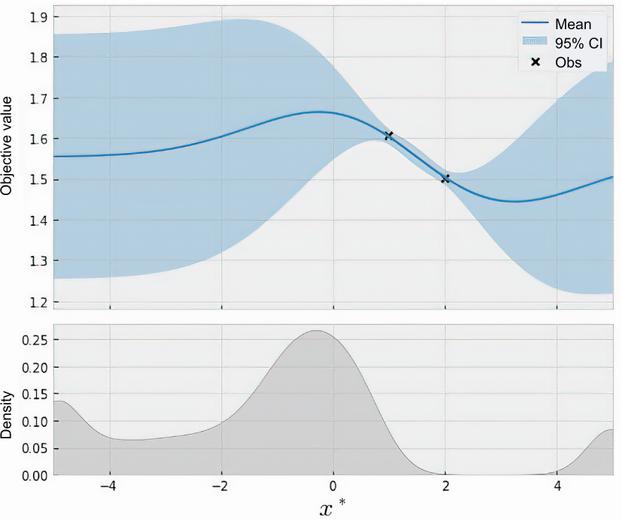
Visualizes a Gaussian-process belief alongside the complicated, non-Gaussian distribution it induces over the optimizer. section 6.2.1
