Optuna automates hyperparameter searches for model training. It helps replace impractical manual tuning with repeatable trials that can improve model quality while controlling training time and memory use. section 5.0 section 5.4.2
Use Optuna as a lightweight Python library when models run on local machines or small managed clusters. It supports large search spaces, early pruning of unpromising trials, parallel execution, and interactive visualization of parameter interactions. section 5.4 section 5.4.2
A typical Optuna workflow has three responsibilities:
- Define an objective function that receives trial hyperparameters, trains a model, evaluates it, and returns a numeric score. section 5.4
- Create a study representing the optimization process and configure a maximum trial quota. section 5.4.2
- Generate values with trial.suggest_xxx calls, then share persistent study storage when running trials across processes or machines. section 5.4.2
Scikit-learn model selection
An objective function can choose between SVR and RandomForest, sample model-specific parameters such as SVR regularization or tree depth, train on a split dataset, and return mean squared error.
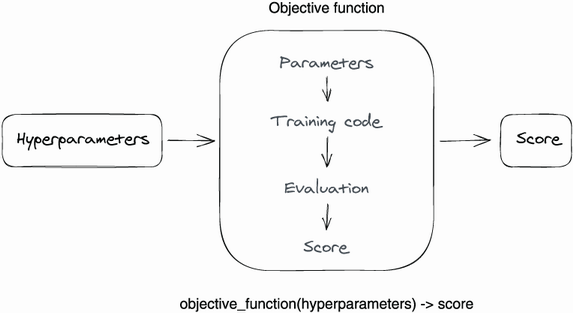
Trace how an objective function converts suggested hyperparameters into a training result and score. section 5.4


