Order batching means placing orders infrequently in relatively large quantities rather than placing smaller recurring orders. The practical question is whether purchasing or delivery economies justify sending a lumpier demand signal upstream. section 4.2.2
Larger batches commonly appear farther upstream, where full-truckload discounts and longer review periods encourage fewer orders. The trade-off is delayed and distorted demand information. section 4.2.2
Order batching affects supply-chain planning by:
- Making upstream orders fewer, larger, and lumpier than the underlying customer demand. section 4.2.2
- Delaying outbound order information relative to incoming demand. section 4.2.2
- Amplifying the bullwhip effect when upstream nodes plan from distorted orders rather than actual demand. section 4.2
A steady market, a lumpy signal
End-customer demand can remain stable while a retailer places occasional large orders with a manufacturer. The manufacturer then sees substantial order variation even though the final market is steady. section 4.2
A practical response is to redesign pricing and logistics so clients place frequent small orders, while also ordering from suppliers frequently enough to preserve the demand signal. Information sharing can further reduce reliance on distorted orders. section 4.3.2
Figure 4.3 Bullwhip effect (the local sales pattern is illustrated above each stage; this is an illustration from my book Inventory Optimization: Models and Simulations).7
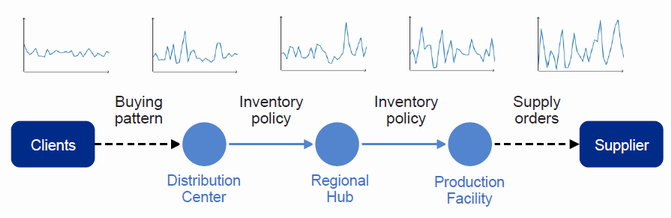
Use the bullwhip-effect figure to inspect how local sales patterns change across supply-chain stages. section 4.2
