liveBook · Manning

Ordered dithering

As explained in How Computers Make Books

Ordered dithering is a dithering technique that uses a fixed spatial threshold pattern to represent intermediate tones with discrete output values.

Ordered dithering turns intermediate gray into black-and-white pixels using a repeating spatial threshold pattern. Ink gathers into adjacent spots, making the result better suited to paper printing. section 8.3

A growing spot

A 2×2 threshold table produces five gray levels: each successive level blackens more pixels. A 4×4 table produces 17 levels, giving smoother tonal transitions but fewer dots overall. Tiled across a page, the black spot grows while the remaining white corners form white spots. section 8.3

Figure 8.22 Our pictures using the 4 × 4 halftone
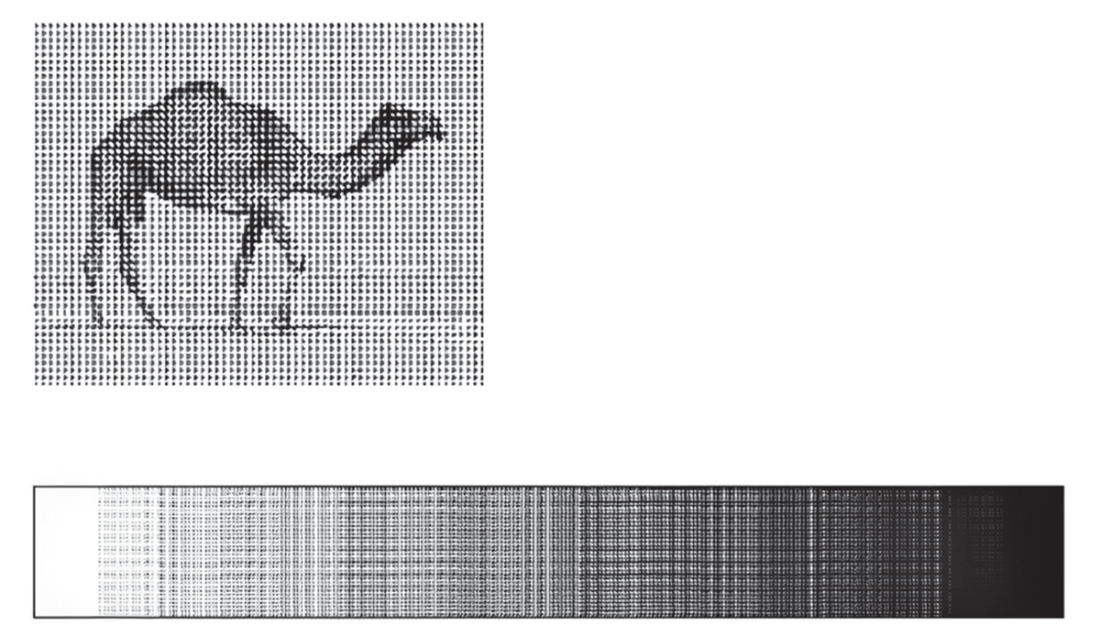
Compare the 4×4 dither patterns and their effect on a camel and a gradient. section 8.3

How How Computers Make Books covers it

How deep it goes
Explains threshold tables, pattern growth, and resolution trade-offs, but stops short of implementation details.
Examples
Uses 2×2 and 4×4 threshold patterns, gradients, a camel image, and microscope views of printed halftones.
What you can do after
Evaluate how pattern size changes tonal smoothness, apparent resolution, and printed spot structure.
How it connects
Connects halftoning with gray levels, resolution, ink spreading, and color printing screens.

Related concepts

This explainer was generated by Manning's knowledge graph from the text of How Computers Make Books. The section links point to the parts of the book it draws on.