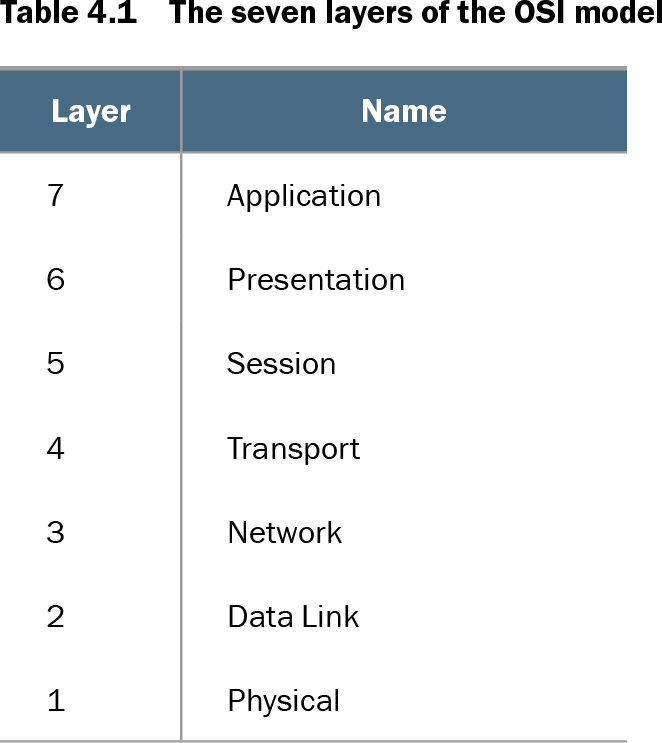
The Open Systems Interconnection (OSI) model is a seven-layer conceptual framework for organizing the functions required for network communication. It helps explain how protocols cooperate as data travels from source to destination, although modern networks use TCP/IP instead. section 4.0 section 4.2
Remember the seven layers from Layer 1 to Layer 7:
- Physical, Data Link, Network, Transport, Session, Presentation, Application. section 4.2
- Use the mnemonic “Please Do Not Teach Students Pointless Acronyms.” section 4.2
- Treat the OSI layers as a vocabulary for discussing network functions, not as the model currently used to implement modern networks. section 4.1 section 4.4
Table 4.1 The seven layers of the OSI model (view table figure)
| Layer |
Name |
|---|---|
| 7 |
Application |
| 6 |
Presentation |
| 5 |
Session |
| 4 |
Transport |
| 3 |
Network |
| 2 |
Data Link |
| 1 |
Physical |
Use the layer table to review the seven layer names, numbers, and order. section 4.2
Why layers matter
An email application does not need to know whether its message travels over Ethernet or Wi-Fi; each layer performs its role behind the application. section 4.1