The OSI model is a seven-layer framework for describing what systems need to communicate. It separates physical transmission, networking, transport, sessions, data representation, and application communication. section 9.3
Read the layers from the physical medium upward:
- Physical: carries signals over media such as cables. section 9.3
- Data Link: delivers frames between local-network nodes using MAC addresses and handles transmission errors. section 9.3
- Network: delivers packets using IP addresses. section 9.3
- Transport: moves data between endpoints; TCP and UDP are common implementations. section 9.3
- Session: establishes, maintains, and closes continuing exchanges between nodes. section 9.3
- Presentation: translates and encodes data applications can consume, such as serialized JSON. section 9.3
For API security, the model helps locate exposure below the application itself. DoS and port-scanning attacks commonly target layers 3–6, while application attacks such as SQL injection and XSS require application-layer defenses. section 9.3 section 9.5
Figure 9.13 The OSI model breaks the elements required to enable communication between systems into seven layers. Layer 1 describes the physical medium, such as switches and cables, and layer 7 describes the application layer, such as APIs. Many API attacks target layers 3–6 and demand special security measures.
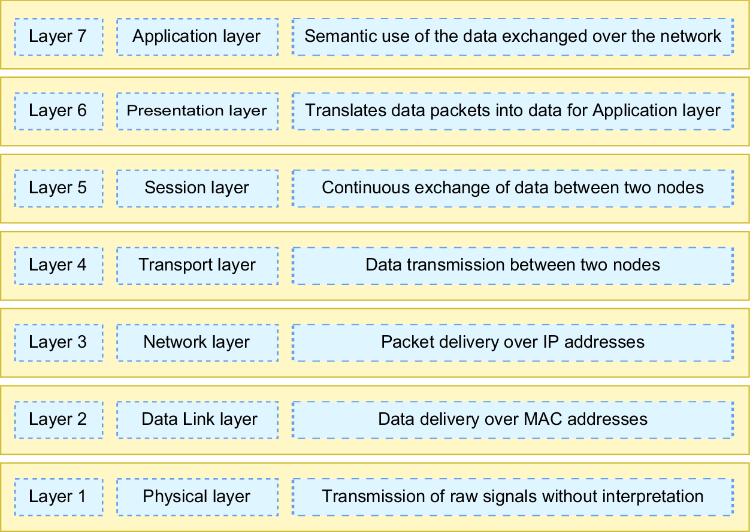
Use the layered diagram to connect physical infrastructure at layer 1 with APIs at layer 7 and identify where security measures apply. section 9.3

