An OSPF area border router (ABR) connects one or more nonbackbone areas to area 0, the OSPF backbone. Because nonbackbone areas cannot connect directly to one another, inter-area traffic passes through the backbone. section 18.1.2
Key properties of an ABR include:
- It has at least one interface in area 0 and connects that backbone to one or more other areas. section 18.1.2
- It maintains a separate link-state database (LSDB) for each area to which it is connected. section 18.1.2
- It is also a backbone router, although a backbone router is not necessarily an ABR. section 18.1.2
- Routes to destinations in areas the router does not connect to are inter-area routes. section 18.1.2
Multi-area example
In a four-area OSPF network, area 0 is the backbone and areas 1, 2, and 3 are nonbackbone areas. Routers R3, R4, and R5 are ABRs because they connect one or more of those areas to area 0. section 18.1.2
Figure 18.2 A multi-area OSPF network consisting of four areas. Area 0 is the backbone area to which other areas must connect. Areas 1, 2, and 3 are non-backbone areas, and traffic between them must pass through area 0.
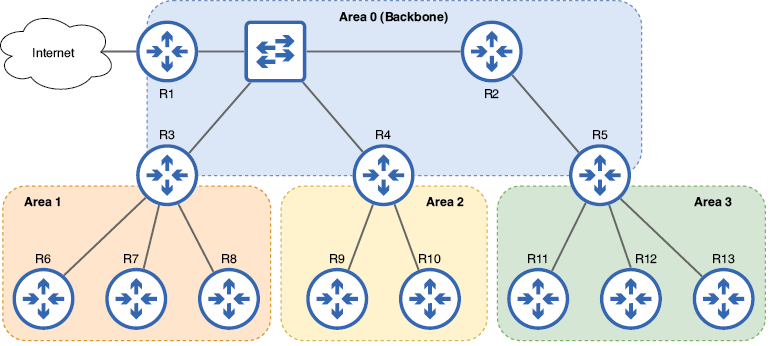
Use the topology to trace how nonbackbone areas connect through area 0 and why traffic between them crosses the backbone. section 18.1.2
