An autonomous system boundary router (ASBR) connects an OSPF autonomous system to external networks, such as the internet or another enterprise network. External destinations advertised by an ASBR become external OSPF routes. section 18.1.2 section 18.5
Keep these distinctions clear for troubleshooting and exams:
- An ASBR classification is independent of other OSPF router types: one router can also be an internal router, backbone router, or ABR. section 18.1.2
- An ASBR can advertise a default route so other OSPF routers use it to reach destinations outside the OSPF autonomous system. section 18.2.4
- Configure the default route first; default-information originate requires that route in the ASBR’s own routing table. section 18.2.4
Advertising internet access through R1
On R1, configure `ip route 0.0.0.0 0.0.0.0 203.0.113.2`, enter OSPF configuration, and issue `default-information originate`. `show ip protocols` identifies R1 as an ASBR, while R2’s `show ip route ospf` output shows an `O*E2 0.0.0.0/0` external default route. section 18.2.4
Figure 18.2 A multi-area OSPF network consisting of four areas. Area 0 is the backbone area to which other areas must connect. Areas 1, 2, and 3 are non-backbone areas, and traffic between them must pass through area 0.
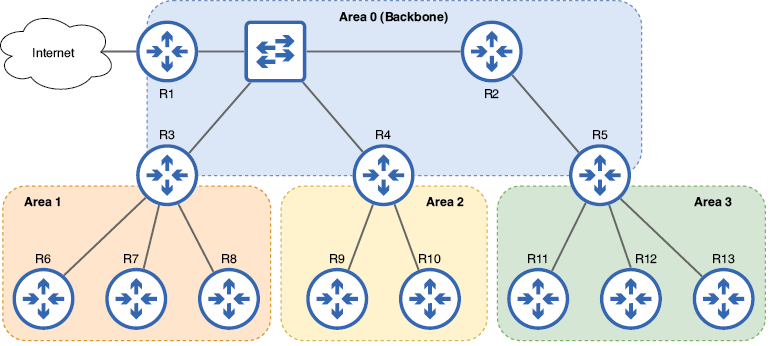
Use the multi-area topology to see how an ASBR can coexist with other OSPF router classifications and how external connectivity fits beside area connectivity. section 18.1.2
