An out-of-band channel is a communication path separate from the main protocol. It helps devices establish trust by carrying authentication information or public key material when the primary connection may be controlled by an attacker. section 10.2 section 11.3.1
Consider pairing two devices over Bluetooth or Wi-Fi. The connection may be vulnerable to a man-in-the-middle attack, while a device screen or an in-person exchange can authenticate a small amount of information. The out-of-band path usually offers integrity and authenticity, but little confidentiality. section 11.3.1
A practical pairing flow separates the channels:
- Use the insecure primary connection for normal communication, while assuming an attacker may control it. section 11.3.1
- Display a public key or digest through the authenticated out-of-band path. section 11.3.1
- Transfer that value by scanning a QR code or typing a human-readable representation. section 11.3.1
- Use the exchanged public keys for a mutually authenticated key exchange. section 11.3.1
A screen as a trust bridge
A phone displays its public key as a QR code. A second device scans it while Bluetooth carries the rest of the protocol. The screen does not need to keep the key secret; it needs to authenticate what is being exchanged. section 11.3.1
Figure 11.13 User-aided authentication protocols that allow a human to pair two devices are modeled with two types of channels between the devices: an insecure channel (for example, NFC, Bluetooth, WiFi, and so on), which we assume is adversary-controlled, and an authenticated channel (for example, real life), which does not provide confidentiality but can be used to exchange relatively small amounts of information.
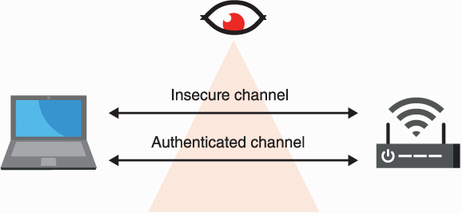
Compare the adversary-controlled insecure channel with the authenticated but low-confidentiality channel used for human-assisted device pairing. section 11.3.1
