liveBook · Manning

Output guard

As explained in Machine Learning Platform Engineering

An output guard is a post-processing protection component that checks or transforms generated responses before delivery.

An output guard is a post-processing protection layer that validates generated responses before delivery. It preserves professional boundaries, enforces business policies, and prevents sensitive information or harmful content from reaching users. In production, it complements input guards and processing controls so one failed defense does not expose the system. section 13.3.1

A production output-guard design can:

  • Check generated sentences for competitor mentions and remove flagged sentences when configured with a fix action. section 13.3.1
  • Work as the final layer after input sanitization and LLM processing, catching violations that earlier controls missed. section 13.3.1

Filtering a competitor mention

A generated response containing a competitor reference passes through an output validator. With on-fail set to fix, the validator removes the offending sentence before delivery. section 13.3.1

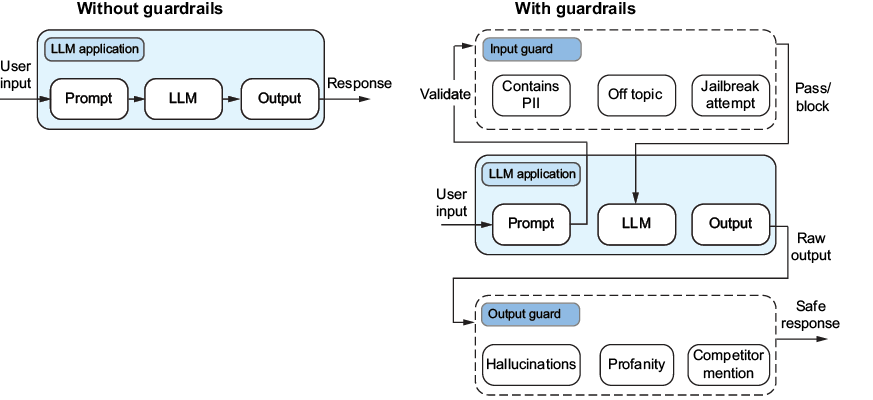
Figure 13.6 Multilayered safety guardrails architecture diagram showing input guards, LLM processing, and output guards workflow
A diagram of a diagram

AI-generated content may be incorrect.

Use the architecture diagram to trace input guards, LLM processing, and output guards as a single protected workflow. section 13.3.1

How Machine Learning Platform Engineering covers it

How deep it goes
Explains the architectural role and competitor-filtering behavior, without detailing a complete output-guard implementation.
Examples
Uses competitor-mention removal, harmful-content prevention, professional-boundary enforcement, and sensitive-information protection.
What it assumes
Assumes an LLM application with user-facing responses and distinguishes output checks from input sanitization.
What you can do after
Operate/configure a multilayer LLM safety pipeline that filters generated responses before users receive them.
How it connects
Connects output validation with input guards, processing controls, PII detection, and business policies.

Related concepts

This explainer was generated by Manning's knowledge graph from the text of Machine Learning Platform Engineering. The section links point to the parts of the book it draws on.