Over-smoothing is a graph neural network failure mode in which repeated message passing makes node representations converge toward similar values, reducing their distinguishability. Each layer expands the receptive field by one hop, but deeper aggregation can dilute node-specific features. section 3.3.2 section 4.5.2
Use model depth as the main practical control:
- Too few layers capture only a limited neighborhood and may produce weak representations. section 3.3.2
- Additional layers capture more hops but increase the risk that node features become indistinguishable. section 3.3.2
- Two- or three-layer GNNs often balance neighborhood coverage and over-smoothing; very deep models can also increase computational complexity. section 3.3.2
- GraphSAGE neighbor sampling can mitigate the effect, while GCNs remain more exposed and GAT attention only partially lowers the risk. section 4.5.2
Comparing depths
A two-layer model can provide a good training and validation profile. A ten-layer model may lower training loss while showing validation degradation, and a 50-layer model can show severe over-smoothing or over-fitting. A large problem radius, such as distant influence in a social network, makes depth selection more difficult. section 3.3.2 section 4.5.2
Figure 4.13 Example of over-smoothing based on changing node features
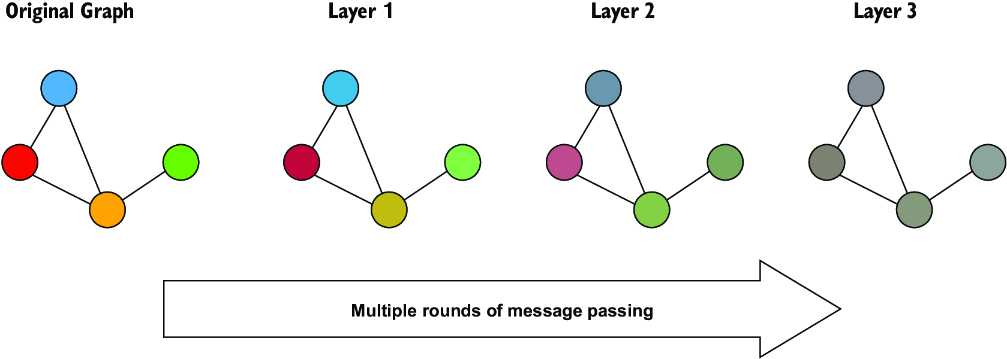
Visualizes how repeated message passing changes node features toward similar representations. section 4.5.2
