Integer overflow occurs when an arithmetic result exceeds the range representable by a fixed-width integer. Instead of expanding, the value wraps: an unsigned all-ones value becomes zero, while signed two’s-complement 127 becomes −128 in a byte. These unexpected values can undermine security-critical calculations. section 10.7
OpenSSH challenge-response allocation
OpenSSH 3.1 parsed attacker-controlled nresp, then allocated nresp * sizeof(char*) bytes. If that multiplication overflowed, the allocation size could be wrong while the following loop still processed the original nresp responses, creating a dangerous memory-handling failure. section 10.7
Figure 10.10 Integer overflows can be illustrated as a ring.
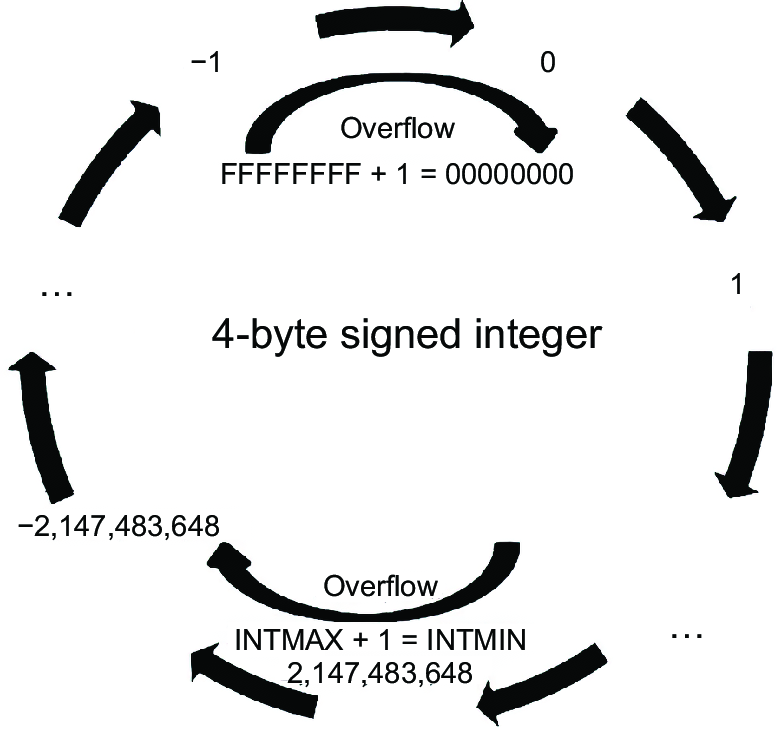
Use the ring diagram to visualize fixed-width arithmetic wrapping around its representable range. section 10.7
Reduce overflow risk in security-sensitive implementations by:
- Checking arithmetic assumptions and avoiding undefined behavior during mathematical operations. section 10.9
- Testing lower-level code extensively, including maximal coverage and fuzzing, because overflow bugs can remain subtle. section 10.9
- Treating integer overflow and type-safety failures as cryptographic implementation risks rather than ordinary arithmetic mistakes. section 10.9






