PageRank estimates a node’s directional, transitive influence. Unlike a direct follower count or node degree, it considers not only how many incoming relationships a node has, but also how influential those connected nodes are. In a follower network, a follow from a highly connected account contributes more influence than a follow from an ordinary account. section 2.3.1 section 5.4.1
Treat each directed relationship as a vote for the node it points to. Start every node with an equal score of 1 divided by the node count. On each iteration, a node divides its current score among its outgoing relationships; each node then sums the scores arriving through incoming relationships. Repeat until scores converge or a chosen iteration limit is reached. section 5.4.1
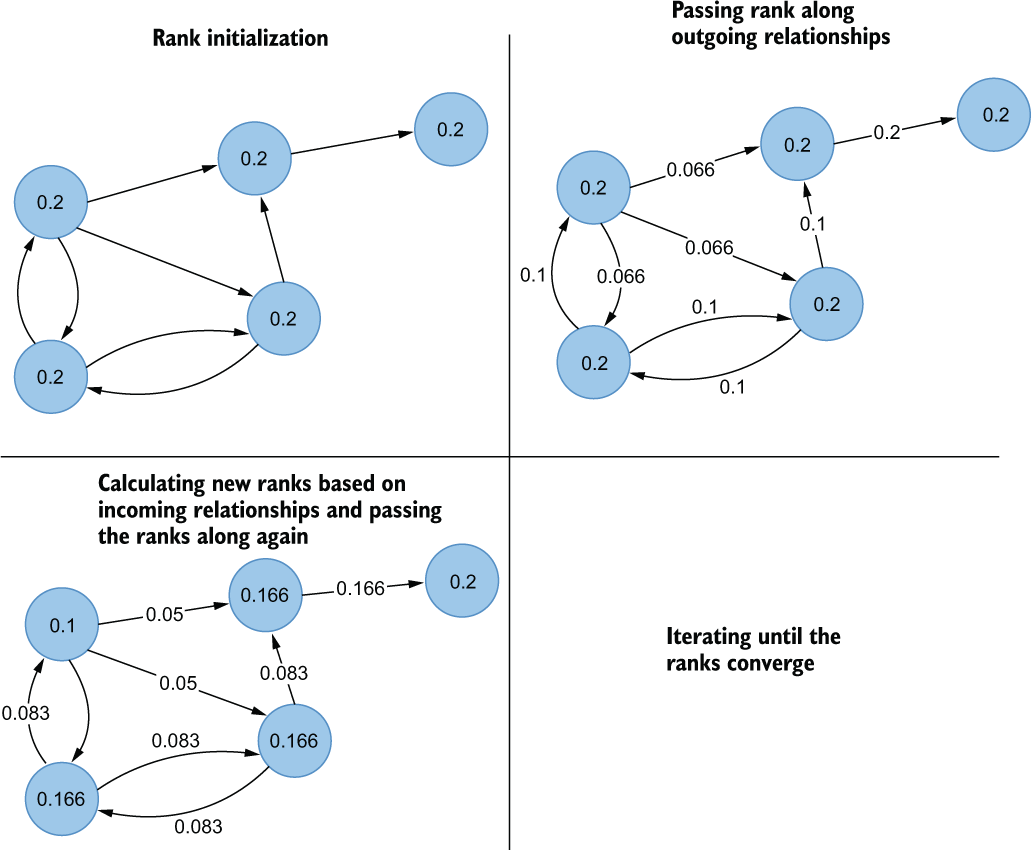
The network-flow diagram makes the iterative transfer of rank across directed relationships visible. section 5.4.1
A node with no outgoing relationships is a dead end: it would leak rank from the network in the simplified calculation. PageRank avoids this with teleportation, a small probability that a random surfer jumps to a random node instead of following an outgoing relationship. The damping factor controls how often the surfer follows a link; with the default 0.85 setting, nodes with no incoming relationships receive 0.15. section 5.4.1 section 5.6
Rank influential accounts
Run PageRank on a projected follower network and write each result to a node property. The highest scores identify accounts with influential followers, not merely large raw follower totals. Inspect the leading accounts’ own highest-ranking followers to interpret why they rank highly. section 5.4.1 section 5.4.1
Listing 5.12 Executing PageRank on the followers network
CALL gds.pageRank.write('follower-network',
 {writeProperty:'followerPageRank'})
This Cypher call runs PageRank on the follower-network projection and persists scores as followerPageRank. section 5.4.1
Use PageRank where influence must flow through a suitable graph structure:
- Rank content creators with the weighted PageRank variant after projecting a network and excluding self-loops. section 6.3
- Find important hashtags only after converting tweet–hashtag data into a monopartite co-occurrence network; a bipartite graph does not let influence flow appropriately between same-type nodes. section 7.0
- Select a few representatives from a large label-propagation community by filtering its subgraph and ranking its nodes separately. section 7.5
- Use Personalized PageRank when teleportation should begin from specified nodes, producing a point-of-view-specific ranking. section 5.6


