Pair trading offsets market exposure by going long on one asset and short on another, usually within the same industry or among correlated assets. It seeks profit from relative performance rather than market direction. section 7.4.3
A relative-performance trade
Buy $100 of Company A, which has stronger growth potential, and short $100 of Company B, which is slowing. If A rises more than B, the difference can produce a gain. If both decline, B’s short-side gain may offset A’s loss. Interest on the short position and an incorrect forecast can still turn the trade into a loss. section 7.4.3
Evaluate the trade with these checks:
- Compare the assets’ relative price movements rather than assuming the whole market will rise. section 7.4.3
- Include short-selling interest costs and test the downside if the long asset falls while the short asset rises. section 7.4.3
- Treat correlation as a risk input, not a guarantee that paired assets will continue moving together. section 7.7
Figure 7.5 The investors are long on A and short on B. In the bull case, the long position increases more than the short position, and the long gain minus the short loss is the profit. In a bear case, the short position loses more than the long position. The profit is the gain from the short position minus the loss in the long position.
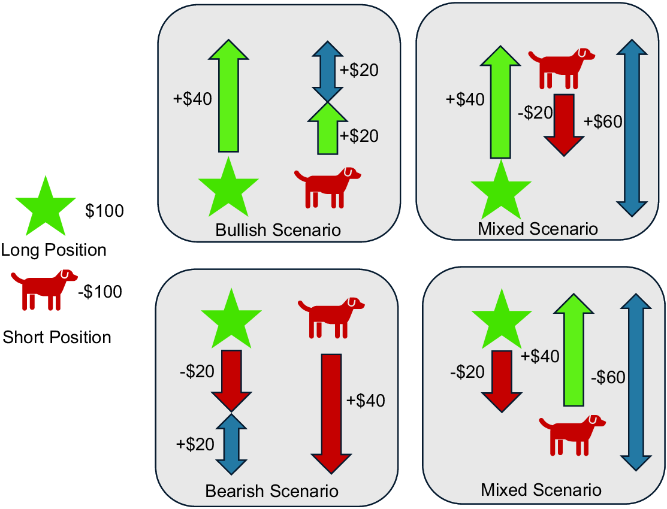
Compare the long gain with the short-side loss across bull and bear cases. section 7.4.3
