A parallel flow lets independent agents work at the same time, then passes their outputs to a downstream step that combines them. Unlike a sequential pipeline, one middle agent does not have to wait for the other to finish before starting. section 4.1.3
A simple flow shape
Think of a task that splits into two independent pieces: start → two agents working simultaneously → combined output. The key design question is whether either agent needs the other’s result. If so, that work belongs in sequence rather than in the parallel middle step. section 4.1.3
Choose the coordination pattern to fit the work:
- Use parallel delegation when multiple tasks or agents can run together to improve performance. section 4.1.3
- Use a sequential pipeline when tasks have a defined order; start with the simplest workable pattern before combining patterns. section 4.1.3
Figure 4.4 Various ways agents may coordinate execution sequentially or in parallel
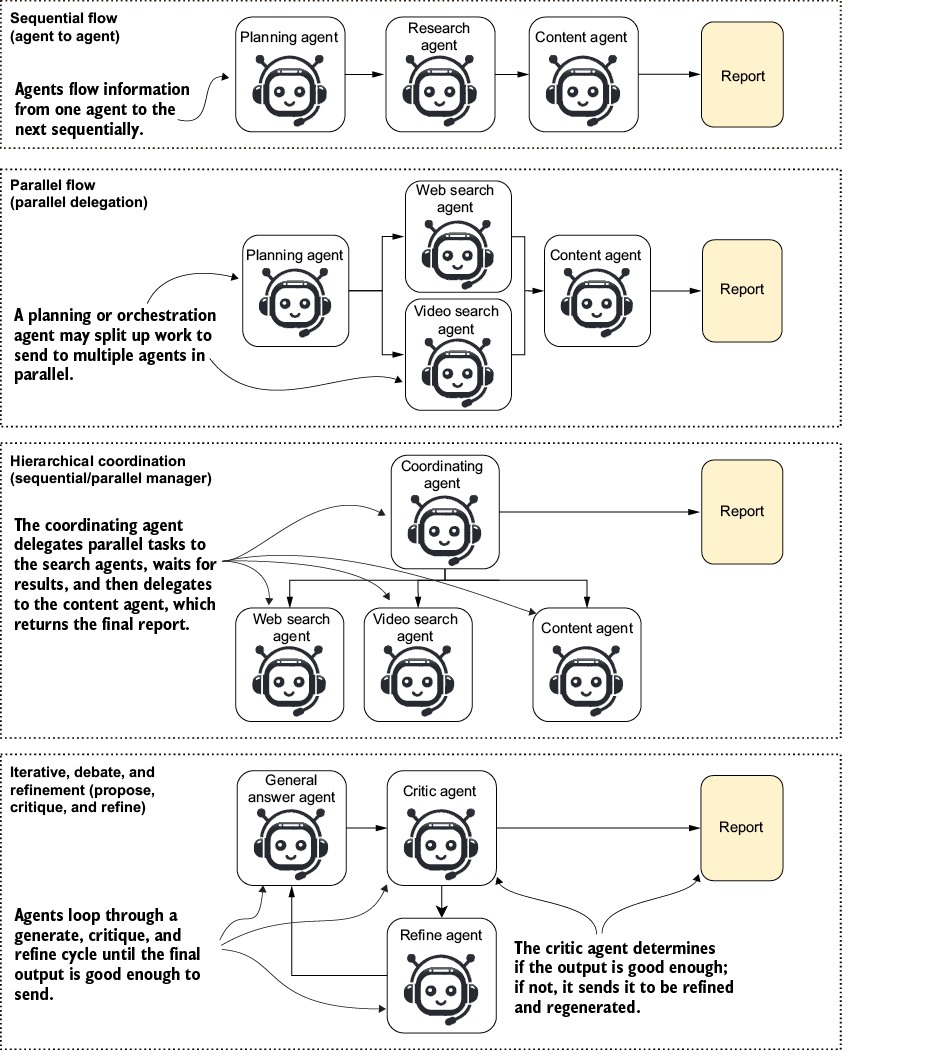
The diagram places parallel flow beside sequential, hierarchical, and iterative coordination shapes, making the difference in execution order easier to see. section 4.1.3

