liveBook · Manning

Parallelepiped

As explained in Geometry for Programmers

A parallelepiped is a three-dimensional polyhedron with six parallelogram faces arranged in three pairs of parallel planes.

A parallelepiped is the three-dimensional shape generated by three vectors. Its signed volume is the scalar triple product a·(b×c), also called the box product. The magnitude gives volume; the sign records the vectors’ orientation. section 9.4.1

The triple-product viewpoint makes several geometric operations practical:

  • Compute the cross product first, then take the dot product; reversing those operations would attempt to cross a scalar with a vector. section 9.4.1
  • Rotate the vectors cyclically without changing the signed volume, but swapping any pair reverses its sign. section 9.4.4
  • Find the same volume by arranging the vectors as a matrix and computing its determinant. section 9.4.1
  • Measure a point’s distance from a plane by dividing the parallelepiped’s signed volume by the base parallelogram’s area. section 9.4.3
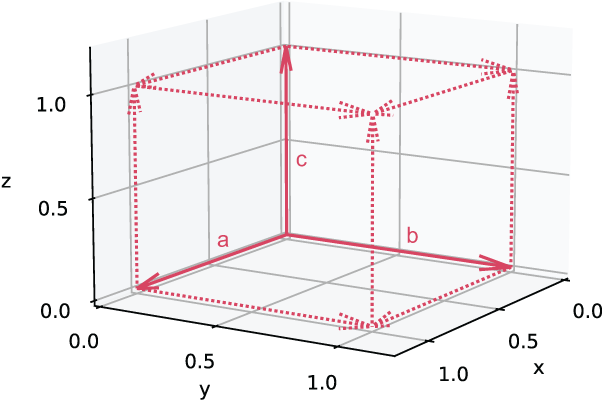
Figure 9.19 The volume of the parallelepiped formed by (1, 0, 0), (0, 1, 0), and (0, 0, 1) is 1.
09-19

The unit vectors (1, 0, 0), (0, 1, 0), and (0, 0, 1) form a parallelepiped with volume 1. section 9.4.1

How Geometry for Programmers covers it

How deep it goes
Explains volume, orientation, operation order, determinants, and a point-plane distance derivation.
Examples
Uses unit vectors for volume one and vectors between four points for point-plane distance.
What it assumes
Assumes familiarity with vectors, dot products, cross products, determinants, and basic plane geometry.
What you can do after
Apply triple products and determinant calculations to obtain signed volumes and point-plane distances.
How it connects
Connects parallelepipeds to scalar triple products, cross products, dot products, determinants, parallelograms, plane normals, and signed volume.

Related concepts

This explainer was generated by Manning's knowledge graph from the text of Geometry for Programmers. The section links point to the parts of the book it draws on.