Signed volume is the oriented volume of the parallelepiped spanned by three vectors. Compute it as the triple product a · (b × c), or as the determinant of a matrix formed from the vectors. section 9.4.1 section 9.8
Use these rules to interpret the value:
- Read the magnitude as the parallelepiped’s volume and the sign as the vectors’ relative orientation. section 9.4.1
- Rotate the operands cyclically without changing the result: (a × b) · c = (c × a) · b = (b × c) · a. section 9.4.4
- Swap two operands to reverse the sign, and compute the cross product before the dot product. section 9.4.1 section 9.4.4
- In two dimensions, the analogous signed volume becomes the signed area of a parallelogram. section 9.5.2
Distance from a point to a plane
For plane points p1, p2, and p3 and another point p, form (p2 − p1) × (p3 − p1). Its dot product with (p − p1) gives signed volume; dividing by the cross product’s length divides by the base area and yields the point-to-plane distance. Reusing the cross product keeps the computation light. section 9.4.3
Figure 9.20 A parallelepiped formed by p2-p1, p3-p2, and p-p1, and the parallelogram formed by p2-p1, p3-p1, too
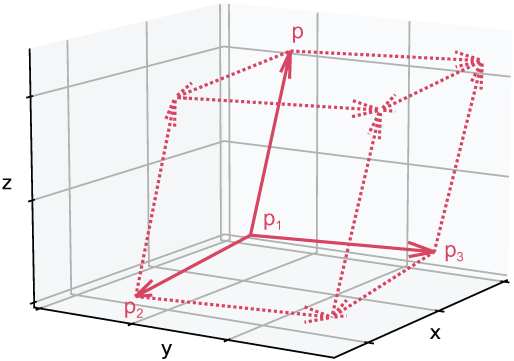
Visualize the parallelepiped built from two vectors in a plane and a third vector reaching toward the point; its height represents the distance to the plane. section 9.4.3
