liveBook · Manning

Parent variable

As explained in Causal Inference for Data Science

A variable that directly determines or influences another variable in a causal graph or structural equation.

A parent variable is a variable that another variable depends on in a causal model. Structural equations represent each endogenous variable as a function of its parents and an exogenous term, such as X := fX(Z, UX). section 7.1.3

This notation allows flexible or unknown relationships: writing a parent into the function permits a causal relationship, without requiring the exact function to be known. section 7.1.3

A three-variable causal graph

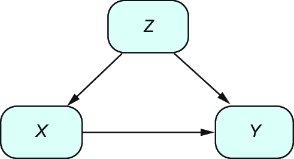
In a graph containing Z, X, and Y, Z can act as a parent of X and contribute to confounding between X and Y. A corresponding dataset records values for Z, X, and Y across observations. section 7.1.3

Figure 7.7 Typical three-node DAG with confounding. Z is a confounder for X and Y.
figure

Inspect the three-node directed acyclic graph to see how a parent variable can participate in confounding. section 7.1.3

How Causal Inference for Data Science covers it

How deep it goes
Defines parents through structural functions and distinguishes exogenous influences, but leaves the exact functions unknown.
Examples
Uses a three-node Z, X, Y confounding graph and a corresponding data table.
What you can do after
Evaluate causal models by expressing variables as functions of their parents without requiring known functional forms.
How it connects
Connects parents to causal graphs, structural equations, endogenous variables, exogenous variables, and confounding.

Related concepts

This explainer was generated by Manning's knowledge graph from the text of Causal Inference for Data Science. The section links point to the parts of the book it draws on.