Partial diffusion diversifies protein structures without discarding their essential architecture. RFDiffusion adds controlled noise to backbone coordinates, preferentially perturbing non-critical regions, then denoises them into alternative structures. section 13.3.3
The noise level controls how far generated structures move from the starting design:
- Low noise makes minor structural adjustments while preserving close similarity to the input. section 13.3.3
- Higher noise explores more distant regions of conformational space. section 13.3.3
- Constraints can preserve an active site, target-binding surface, or other functionally critical region while surrounding structure changes. section 13.3.3
Figure 13.9 Constraint-aware protein engineering pipeline integrating geometric and evolutionary design principles. Unlike the earlier workflows that filter from large libraries, this protein therapeutic workflow generates novel candidates through iterative backbone-sequence co-optimization with explicit preservation of functional constraints. The initial characterization phase establishes "no-go zones" (catalytic residues, binding interfaces) that propagate as hard constraints through downstream stages, while RFDiffusion's structural diversification and LigandMPNN's sequence design explore complementary degrees of freedom, e.g., backbone geometry and amino acid identity, respectively. The feedback loop from AlphaFold2 validation enables rejection and regeneration of structurally implausible designs before experimental commitment, demonstrating how structure prediction models transition from discovery tools (workflow input) to validation oracles (quality gates).
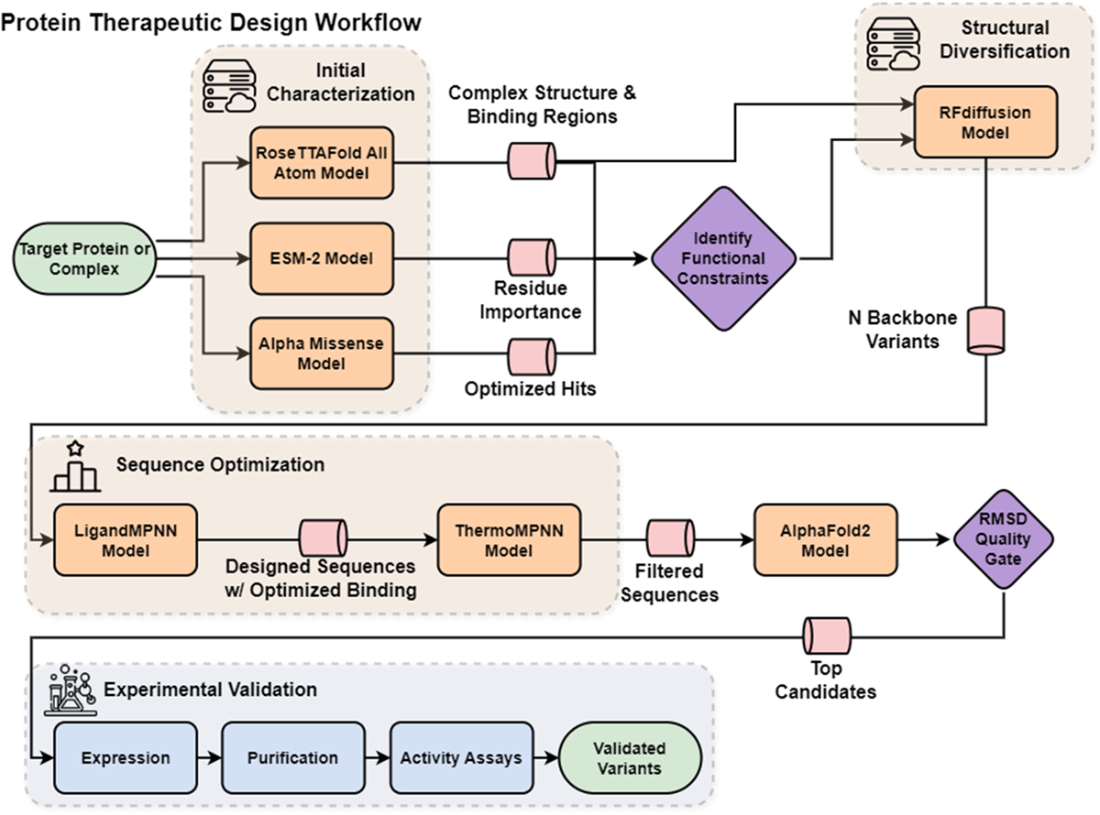
The constraint-aware pipeline shows how partial diffusion fits into protein design: preserve no-go zones, diversify backbones, design sequences, and validate candidates before experiments. section 13.3.3
