RFdiffusion is a diffusion model for generating protein backbone structures: the structural framework on which amino acid sequences are arranged. It can design a new binder for a known target site when no natural protein binds with sufficient affinity. Its output is a backbone, not a finished amino acid sequence. section 13.2.1
During training, RFdiffusion learns to reverse noise added to known protein structures. To generate a new backbone, it starts from random noise and refines it iteratively. Generation can be conditioned on requirements such as a binding geometry or a structural motif, preserving features needed for the intended design. section 13.2.1
Partial diffusion instead starts with an existing backbone. Controlled noise perturbs the structure, preferentially in non-critical regions, before the model denoises it. Low noise produces minor changes; higher noise explores more distant structural alternatives. Constraints can preserve an enzyme’s active-site geometry while surrounding loops are redesigned, or preserve a target binding surface while other surfaces are varied. section 13.3.3
Protein binder design workflow
Given a target protein structure predicted by AlphaFold2, RFdiffusion can generate a binder backbone while exploring a specified binding interface. ProteinMPNN then designs amino acid sequences for that backbone, and AlphaFold2-Multimer predicts the resulting complexes for interaction and stability assessment. These predictions are not a guarantee of correct binding-site geometry or successful binding. section 13.2.1
Figure 13.9 Constraint-aware protein engineering pipeline integrating geometric and evolutionary design principles. Unlike the earlier workflows that filter from large libraries, this protein therapeutic workflow generates novel candidates through iterative backbone-sequence co-optimization with explicit preservation of functional constraints. The initial characterization phase establishes "no-go zones" (catalytic residues, binding interfaces) that propagate as hard constraints through downstream stages, while RFDiffusion's structural diversification and LigandMPNN's sequence design explore complementary degrees of freedom, e.g., backbone geometry and amino acid identity, respectively. The feedback loop from AlphaFold2 validation enables rejection and regeneration of structurally implausible designs before experimental commitment, demonstrating how structure prediction models transition from discovery tools (workflow input) to validation oracles (quality gates).
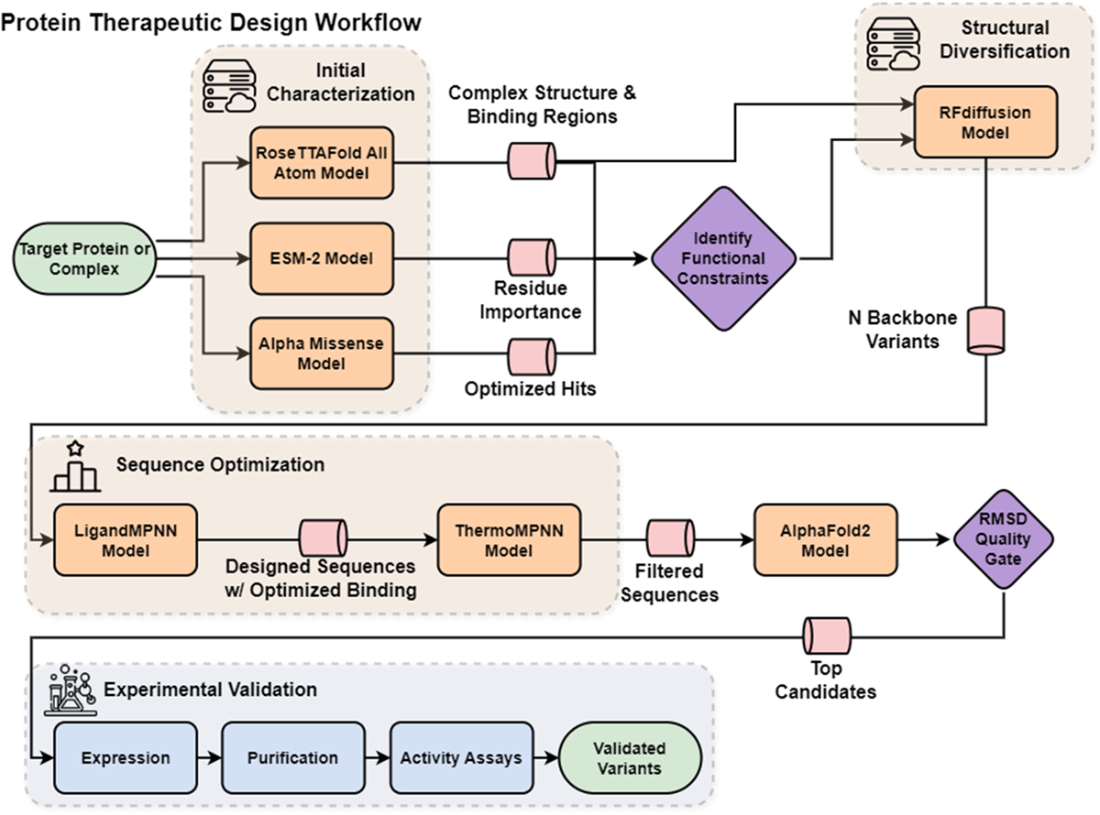
Follow a constraint-aware workflow in which RFdiffusion varies backbone geometry, sequence design explores amino acid choices, and structure prediction helps reject implausible candidates. section 13.3.3
