A partially labeled scale gives verbal descriptors only for selected response points, usually the endpoints and midpoint. It simplifies the display and may reduce respondent cognitive load compared with labeling every point. section 6.2.2
Use the format with awareness of its main tradeoff:
- Unlabeled points can be interpreted inconsistently—for example, respondents may distinguish differently between “Slightly Agree,” “Agree,” and “Somewhat Agree.” section 6.2.2
- Keep response-option order consistent across a survey; counterbalance positive-to-negative and negative-to-positive orders when directional skew is a concern. section 6.2.2
Selected verbal anchors
A response scale might label “Strongly Disagree,” a midpoint, and “Strongly Agree,” while leaving intermediate points unlabeled. This reduces visual complexity but leaves more meaning for respondents to infer. section 6.2.2
Figure 6.6 Varying methods of presenting the same response format
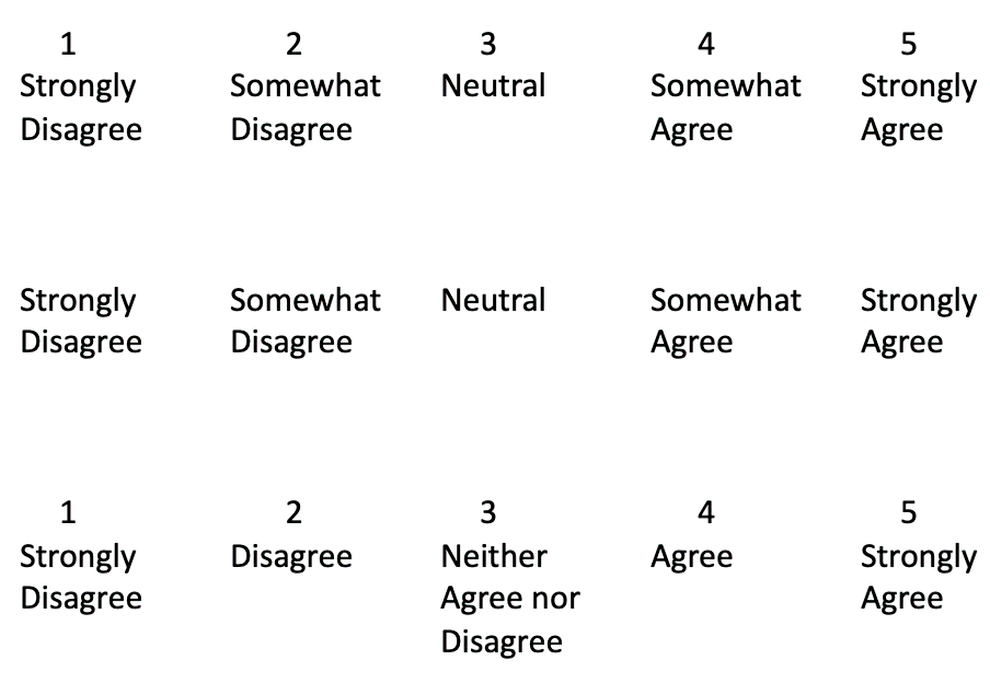
Compare partially labeled scales with fully labeled and unlabeled numerical presentations of the same response format. section 6.2.2
