Participant observation is an anthropological method for understanding a culture from inside it. In collaborative modeling, it helps a facilitator notice how organizational culture shapes who speaks, who waits, and whose views influence the group. Explicit authority alone does not explain influence; implicit power can be carried through shared symbols that evoke reactions and emotions. section 6.3.1
The emic perspective captures lived experience within the culture. The etic perspective is an outsider’s interpretation of the stories and observations collected. Holding both perspectives supports more informed judgments about power dynamics without mistaking an observer’s first interpretation for the whole situation. section 6.3.1
Use participant observation during preparation and facilitation:
- Watch for cultural symbols, repeated reactions, and informal patterns of influence rather than relying only on formal roles. section 6.3.1
- Collect anecdotes about what people do, hesitate to do, and react to; then distinguish participants’ lived experiences from your own conclusions. section 6.3.1
- Map symbols, anecdotes, and facilitator reflections so observations can be discussed and connected to session design. section 6.3.1
- Record your own emotions and prejudices alongside group events, because suppressing them can undermine neutrality later. section 5.2.1
When silence signals more than uncertainty
In a Big Picture EventStorming session, someone may fear writing the wrong domain event and wait for another person to post an example. Treat that hesitation as evidence to explore, not proof of a personal deficit. Ask what makes contribution feel risky, observe who establishes acceptable examples, and consider how informal influence affects participation. section 6.3.1
Participant observation does not require perfect neutrality. Preconceptions and emotions cannot simply be removed; acknowledging and understanding them makes it easier to stay open to ideas and avoid reacting against participants without realizing it. section 5.2.1
Figure 6.3 An example map of how to model the organization and capture symbols, anecdotes, and our own thoughts. In reality, this would be a lot bigger, so we like to use online tools where we can easily enlarge the area and collaborate on capturing our observations.
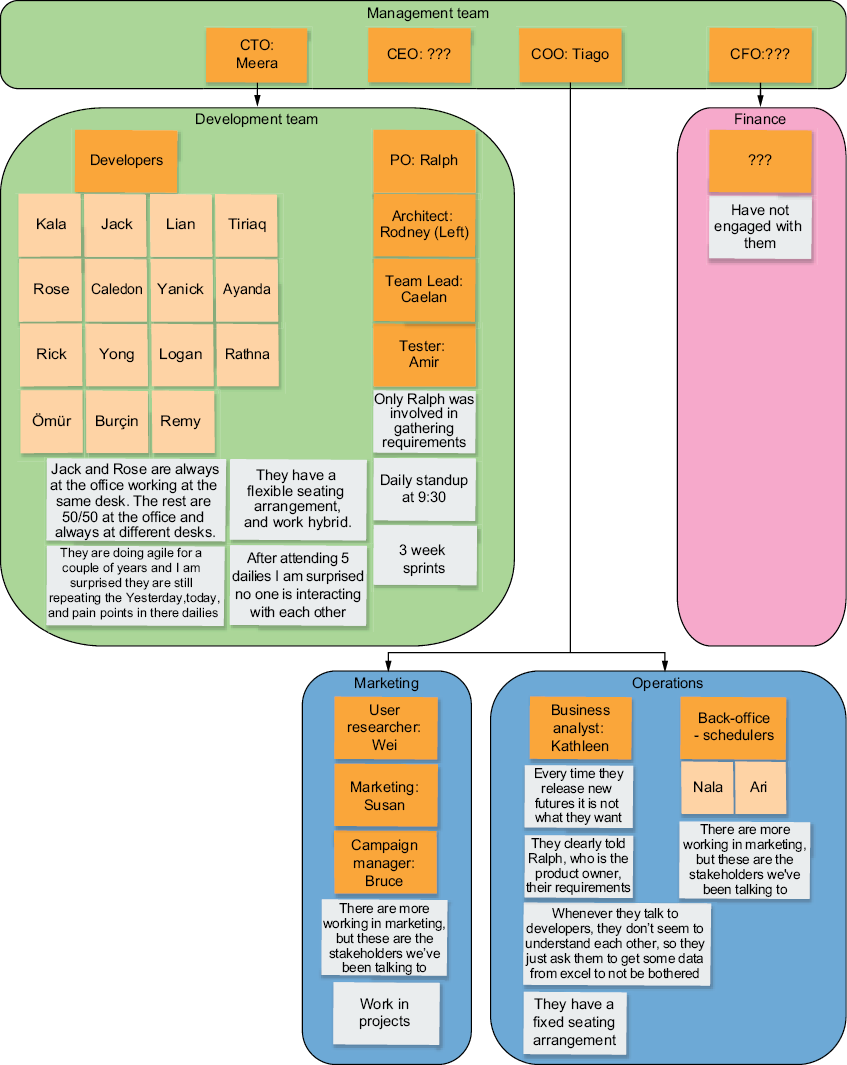
Use the observation map to capture organizational symbols, anecdotes, and your own reflections in a shared workspace. section 6.3.1
