Path-to-text translation converts graph paths and relationship types into natural-language sentences so language models can interpret relational evidence during biomedical named entity disambiguation. section 8.4.3
A practical translation pipeline proceeds as follows:
- Detect short paths between candidate entities, typically limiting searches to one or two hops and excluding highly connected hub nodes. section 8.4.3
- Format each path with entity names, relationship directions, and relationship types before sending it to a language model. section 8.4.3
- Require exact entity names and valid JSON so translated sentences can be processed reliably downstream. section 8.4.3
- Summarize the translated sentences into synthetic context for the final disambiguation decision. section 8.4.3
Biomedical risk-path translation
The path `(Hypertension)-[:RISK_FACTOR_FOR]->(Cardiovascular Disease)<-[:ASSOCIATED_WITH]-(Myocardial Infarction)` becomes a sentence stating that hypertension is a risk factor for cardiovascular disease, while myocardial infarction is also associated with it. The resulting context supports entity disambiguation. section 8.4.3
Figure 8.6 NED CD steps: (1) detecting the shortest paths between all the candidates related to the entity mentions in the sentence; (2) translating detected paths into natural language sentences; (3) summarizing those sentences into useful text for disambiguation
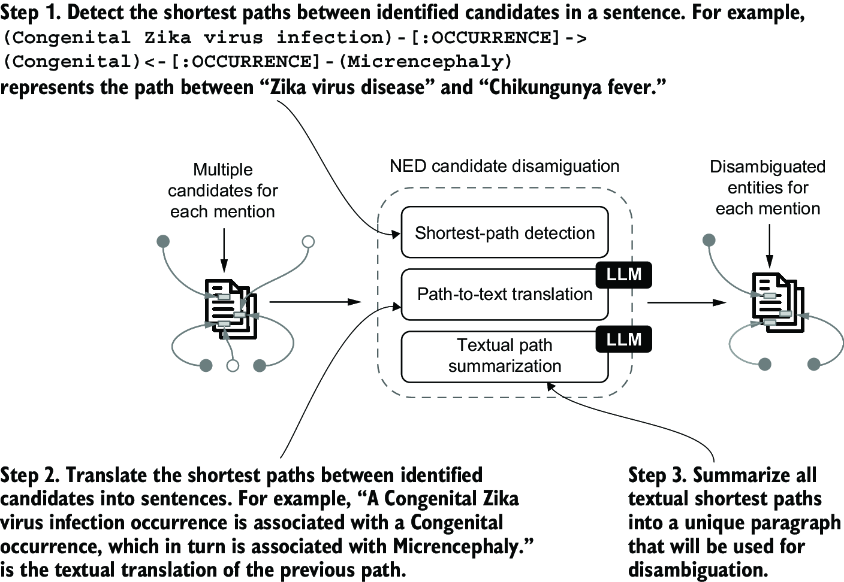
Follow the three-stage workflow: detect shortest paths, translate them into natural-language sentences, and summarize the resulting context. section 8.4.3
