liveBook · Manning

Candidate disambiguation

As explained in Knowledge Graphs and LLMs in Action

Candidate disambiguation is the phase of named entity disambiguation that uses contextual and ontology-based evidence to select the intended entity from candidate entities.

Candidate disambiguation is the final named entity disambiguation phase: it selects the intended entity from generated candidates by combining co-occurring context with domain-ontology evidence. section 8.4 section 8.4.3

A practical candidate-disambiguation pipeline proceeds as follows:

  • Detect shortest paths between candidates associated with different mentions in the sentence. section 8.4.3

Zika and microcephaly

When a sentence mentions “Zika” with “microcephaly,” their co-occurrence favors Congenital Zika virus infection over a general virus interpretation; the resulting selections can be returned with SNOMED identifiers. section 8.4.3

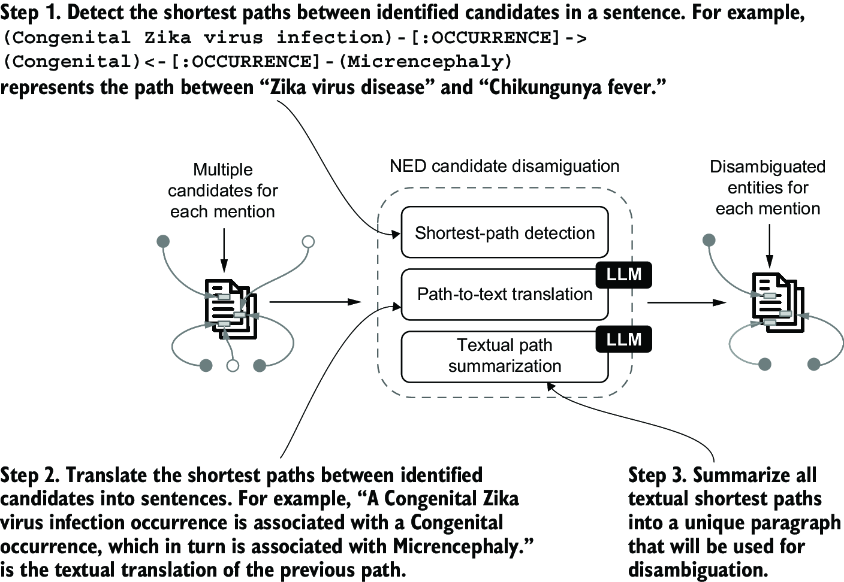
Figure 8.6 NED CD steps: (1) detecting the shortest paths between all the candidates related to the entity mentions in the sentence; (2) translating detected paths into natural language sentences; (3) summarizing those sentences into useful text for disambiguation
figure

The workflow diagram shows the three operational steps: shortest-path detection, path translation, and textual summarization. section 8.4.3

How Knowledge Graphs and LLMs in Action covers it

How deep it goes
Explains a three-step graph-to-text pipeline and final contextual selection, using shortest paths, translation, and summarization.
Examples
Uses Zika, microcephaly, congenital malformations, SNOMED paths, Neo4j queries, translated sentences, and structured disambiguation results.
What it assumes
Assumes identified mentions, generated candidate entities, a structured domain ontology, and an LLM capable of processing textual context.
What you can do after
Apply it via Neo4j Graph Data Science and LLM prompts to produce ontology-linked entity choices with contextual support.
How it connects
Connects named entity disambiguation with candidate selection, knowledge graphs, domain ontologies, large language models, and shortest-path algorithms.

Related concepts

This explainer was generated by Manning's knowledge graph from the text of Knowledge Graphs and LLMs in Action. The section links point to the parts of the book it draws on.