Textual path summarization condenses relationships extracted from graph paths into a concise natural-language context. In named entity disambiguation, it helps a large language model compare candidate biomedical entities using relational evidence rather than isolated labels. section 8.4.3 section 8.5
A practical pipeline separates graph retrieval from language processing:
- Detect short paths between candidate entities, limiting path length and excluding highly connected hub nodes that produce generic relationships. section 8.4.3
- Translate each path into a sentence while preserving the exact entity names and returning structured JSON. section 8.4.3
- Summarize the resulting sentences into shared context that emphasizes recurring entities and relationships. section 8.4.3
- Pass the summary to the final disambiguation prompt alongside the original sentence and candidate entities. section 8.4.3
Biomedical candidate context
Paths linking Congenital Zika virus infection through Congenital to Micrencephaly, Acrocephaly, and other malformations become a summary stating that the infection is associated with various congenital malformations sharing a common link to Congenital. section 8.4.3
Figure 8.6 NED CD steps: (1) detecting the shortest paths between all the candidates related to the entity mentions in the sentence; (2) translating detected paths into natural language sentences; (3) summarizing those sentences into useful text for disambiguation
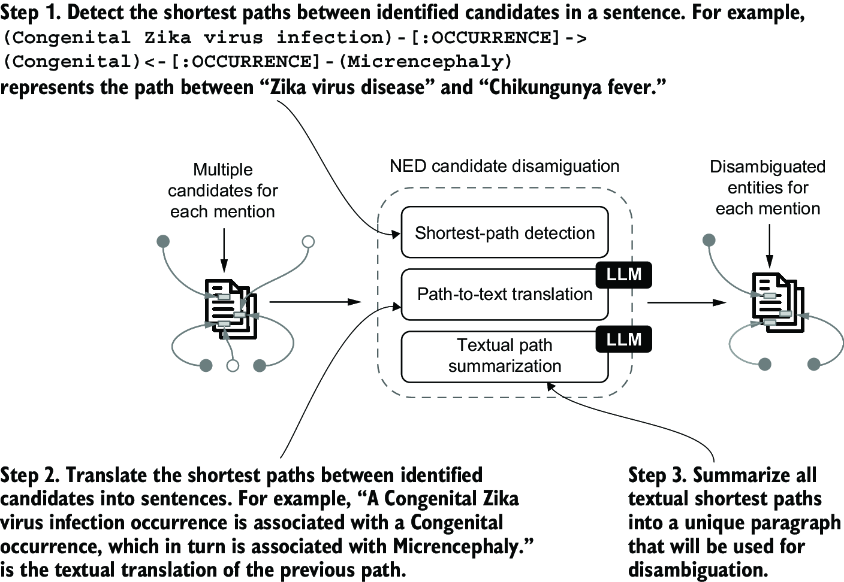
The pipeline is organized as shortest-path detection, path translation into natural-language sentences, and summarization for disambiguation. section 8.4.3
