A payload is the contents carried inside a protocol data unit (PDU), excluding that unit’s protocol control information, such as its header or trailer. The payload changes meaning as data moves through the TCP/IP layers. section 4.3.2
Track the nested payloads during encapsulation:
- Application data is the payload of a segment. section 4.3.2
- A segment is the payload of a packet. section 4.3.2
- A packet is the payload of a frame. section 4.3.2
Following data through the layers
A host adds a Layer 4 header to application data, creating a segment; adds a Layer 3 header, creating a packet; then adds a Layer 2 header and trailer, creating a frame. At the destination, those control fields are inspected and removed in reverse order until the application receives the data. section 4.3.2 section 4.4
Figure 4.7 Application data encapsulated in a Layer 4 header is a segment (L4PDU); a segment encapsulated in a Layer 3 header is a packet (L3PDU); and a packet encapsulated in a Layer 2 header/trailer is a frame (L2PDU). The encapsulated contents of each PDU are that PDU’s payload.
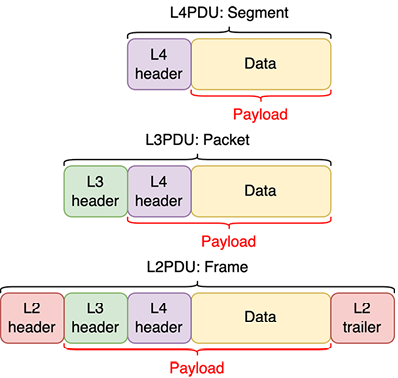
Use the PDU diagram to see how each layer’s unit becomes the next layer’s payload. section 4.3.2







