liveBook · Manning

Perceiving emotions

As explained in Lead Developer Career Guide

The capability to accurately recognize emotions in oneself and other people.

Perceiving emotions means accurately recognizing emotional states in yourself and other people. It involves noticing facial expressions, body language, and vocal cues, creating a foundation for empathy and effective communication. section 11.1.1

Use emotional perception to:

  • Notice both positive and negative emotions during workplace interactions. section 11.1.1
  • Read several signals together rather than relying on a single expression, gesture, or vocal change. section 11.1.1
  • Respond empathetically and communicate more effectively after identifying the emotional state involved. section 11.1.1
Figure 11.2 Recognizing positive and negative emotions
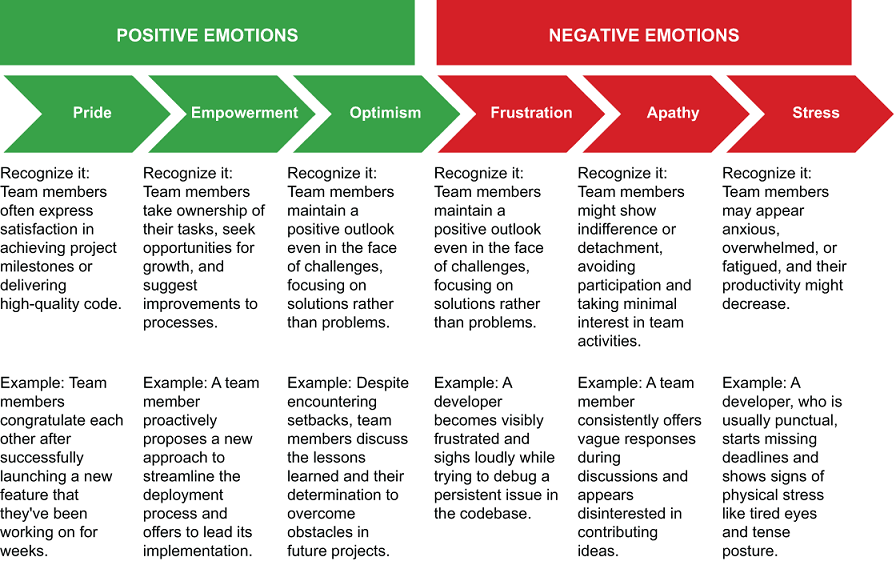
Compare visual examples of positive and negative emotional expressions. section 11.1.1

How Lead Developer Career Guide covers it

How deep it goes
Defines the capability and identifies facial, bodily, and vocal cues without explaining detailed recognition procedures.
Examples
Uses facial expressions, body language, vocal cues, and examples of positive and negative emotions.
What it assumes
Teaches the capability from its definition and assumes no prior emotional-intelligence framework knowledge.
What you can do after
Apply emotional-cue recognition to form empathetic responses and communicate more effectively.
How it connects
Connects perceiving emotions with emotional intelligence, empathy, communication, using emotions, understanding emotions, and managing emotions.

Related concepts

This explainer was generated by Manning's knowledge graph from the text of Lead Developer Career Guide. The section links point to the parts of the book it draws on.