liveBook · Manning

Four-branch model

As explained in Lead Developer Career Guide

A model of emotional intelligence that divides the capability into perceiving emotions, using emotions, understanding emotions, and managing emotions.

The four-branch model divides emotional intelligence into perceiving emotions, using emotions, understanding emotions, and managing emotions. It gives lead developers a practical framework for developing emotional skills and strengthening workplace relationships. section 11.1.1

The four branches address distinct responsibilities:

  • Perceiving emotions: recognizing emotions accurately in yourself and others through facial expressions, body language, and vocal cues. section 11.1.1
  • Using emotions: harnessing emotions to support thinking, decision-making, task prioritization, and creative problem-solving. section 11.1.1
  • Understanding emotions: comprehending complex emotions, their relationships, and their causes and consequences. section 11.1.1
  • Managing emotions: handling emotional states as part of emotional-intelligence practice. section 11.1.1
Figure 11.2 Recognizing positive and negative emotions
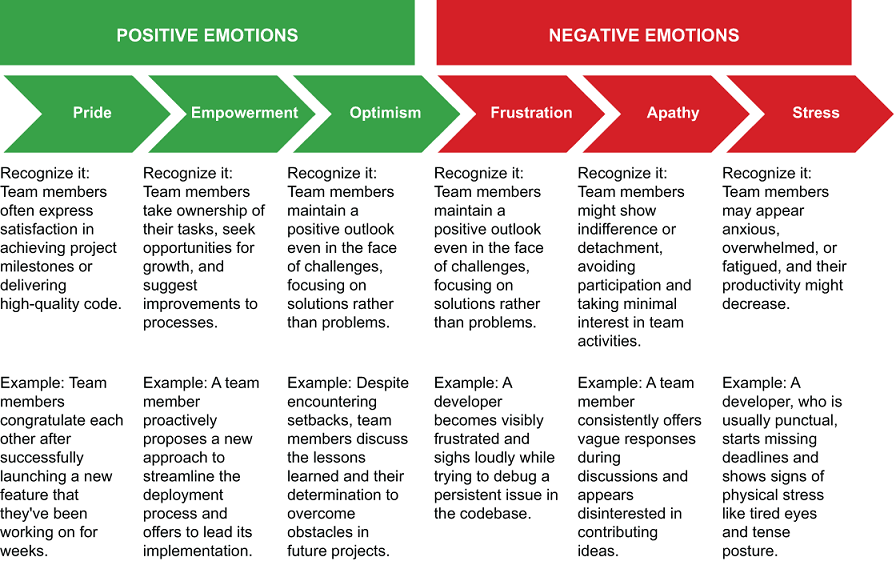
Use the figure to compare how positive and negative emotions may be recognized. section 11.1.1

How Lead Developer Career Guide covers it

How deep it goes
Defines four branches and explains perception, thinking, and emotional understanding, while naming managing emotions as the fourth branch.
Examples
Uses facial expressions, body language, vocal cues, and recognition of positive and negative emotions as examples.
What you can do after
Apply the four branches to develop emotional-intelligence skills for communication, team relationships, and project leadership.
How it connects
Connects emotional intelligence with empathetic responses, effective communication, decision-making, problem-solving, and cognitive processes.

Related concepts

This explainer was generated by Manning's knowledge graph from the text of Lead Developer Career Guide. The section links point to the parts of the book it draws on.