A perceptron is a binary linear classifier: it takes a weighted sum of input features, adds a bias, and applies a step function. Its output is 0 on one side of a hyperplane and 1 on the other, so the weights set the boundary’s orientation while the bias sets its position. section 7.3.3 section 7.6
For an input vector x, the computation is a step function applied to w·x + b. Geometrically, w·x + b = 0 is the decision boundary; changing w rotates or reorients that boundary, while changing b shifts it. A single perceptron therefore succeeds only when the two classes can be separated by one planar surface. section 7.3.3 section 7.6
Figure 7.8 although the input space is 2D, the perceptron graph is 3D. The decision boundary is indicated by the long diagonal straight line. It maps points on one side of the decision boundary to the Z = 0 plane and the points on the other side to the Z = 1 plane.
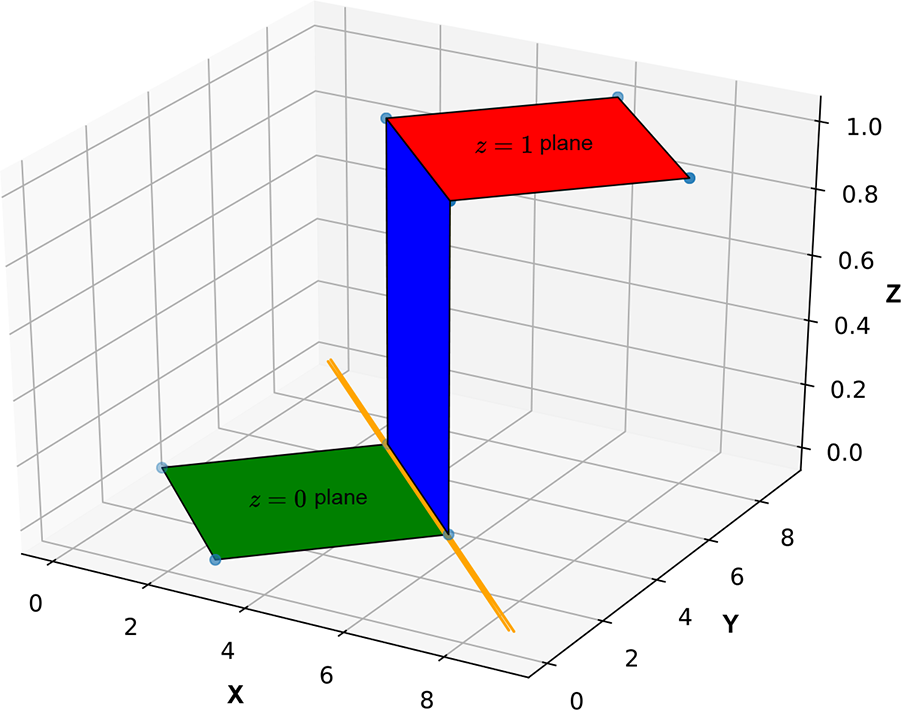
View the thresholded output as two flat output regions separated by a line in a two-dimensional input space. section 7.3.3
A perceptron can express simple Boolean rules by choosing weights and bias values:
- AND uses two positive input weights and a threshold that fires only when both binary inputs are 1. section 7.3.4
- OR and NOT likewise correspond to decision boundaries that separate their binary input points. section 7.3.4
- XOR cannot be represented by one perceptron because no single straight boundary separates its positive and negative points. section 7.4.1
Implementing a threshold unit
A PyTorch-style implementation augments each input with a constant 1, joins the bias to the weights, performs matrix multiplication, and applies torch.heaviside. This treats a batch of inputs as a fully connected layer with a threshold activation. section 7.3.3
Multiple perceptrons overcome the single-boundary limit. Their outputs can be combined in a multilayer perceptron (MLP): for example, several threshold units can enclose a rectangular decision region, and layered units can model XOR. More generally, a single-hidden-layer MLP can approximate continuous functions, although it may require impractically many perceptrons. section 7.4.1 section 7.5.3 section 7.5.4
Hard step functions are expressive but not differentiable at zero, which prevents gradient-based optimization of weights. Training therefore uses differentiable step-like functions such as sigmoid; in layered networks, each unit’s weighted sums are efficiently written as matrix-vector multiplication. section 8.1 section 8.3.1




