The perceptron algorithm trains a binary classifier by repeatedly adjusting its weights and bias from labeled examples. Think of the classifier as a line: it should place one class on one side and the other class on the other side. This makes it useful for tasks such as deciding whether an email is spam, a movie will be watched, or a sentence is happy or sad. section 5.0 section 5.27
Start with a random classifier. Pick a labeled point, make a prediction, and check it. If the point is correct, change nothing. If it is wrong, move the line a little toward that point. In algebraic terms, adjust the weights and bias by a small amount to reduce the point’s error. Repeating this small correction many times can produce a separator that classifies most points well. section 5.14 section 5.15
The training loop has a few important moving parts:
- A labeled dataset supplies features and binary labels, 1 and 0. section 5.15
- A learning rate controls how far weights and bias move after a mistake. section 5.15
- Epochs control how many update attempts are made. section 5.15
- Mean perceptron error tracks progress and can help decide when to stop. section 5.13 section 5.20
A tiny sentiment classifier
Represent each sentence by counts of the words “aack” and “beep.” A line such as #aack − #beep = 0 treats sentences with at least as many “aack” words as happy, and the others as sad. Training shifts the line when a labeled sentence lands on the wrong side. section 5.2 section 5.15
Figure 5.23 If we apply the perceptron trick many times, each time picking a random point, we can imagine that we’ll obtain a classifier that classifies most points correctly.
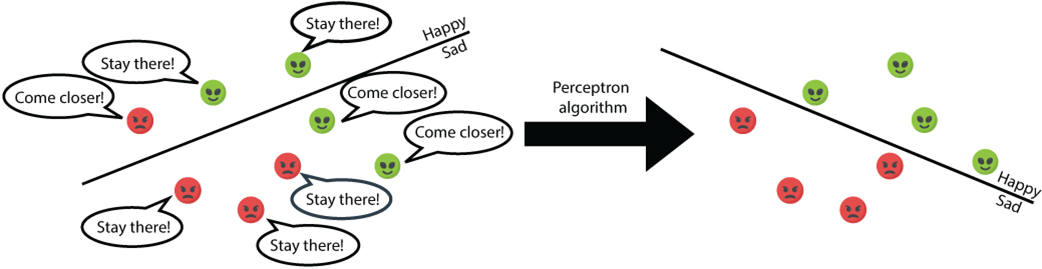
Follow the repeated updates visually: correctly classified points leave the line still, while mistakes pull it closer until the split improves. section 5.15
A simple implementation calculates a score with a dot product plus bias, converts that score to 0 or 1 with a step function, and updates one randomly selected point at a time. Because point selection is random, separate runs can return different weights and bias; a fixed random seed makes a run repeatable. section 5.19 section 5.20
The method aims for a good separator, not necessarily the best possible one. When two classes cannot be separated by a line, it still seeks a line that separates them as well as possible. The same improvement idea can also be viewed as minimizing mean perceptron error with gradient descent. section 5.15 section 5.16

