A periodic quantum state encodes a repeating amplitude pattern across computational-basis outcomes. Its frequency can be estimated by measuring the state, making it a useful bridge from quantum amplitudes to rotation-angle estimates. section 9.0
The measurement outcomes behave like ticks on a ruler. With n qubits there are 2^n possible ticks: an integer frequency concentrates probability on one tick, while a noninteger frequency spreads probability around neighboring ticks. Adding qubits doubles the number of ticks and improves precision. section 9.1.1
Use the frequency–angle relationship to interpret the state:
- Relate the parameters with θ/(2π) = v/2^n, or v = θ2^n/(2π). section 9.1.1
- Treat values differing by 2^n as equivalent because they encode angles differing by a full rotation; estimates therefore wrap modulo 2^n. section 9.1.1
- Read the dominant measurement outcome as an approximate frequency, then convert it back to an estimate of θ. section 9.1.1
Increasing precision with more qubits
For θ = 3.74, three qubits encode v3 = 4.76; five qubits encode v5 = 19.05. A 100-shot measurement produces counts {5: 79, 4: 12, 6: 3, 7: 3, 3: 2, 2: 1} with three qubits, compared with {19: 98, 22: 1, 20: 1} with five qubits. The sharper five-qubit distribution gives a more precise estimate. section 9.1.1
Quantum phase estimation creates this state by preparing an eigenstate, applying controlled powers of a circuit to an estimation register, and applying the inverse quantum Fourier transform. Measurement of that register estimates the circuit’s eigenvalue phase. section 9.3
Figure 9.1 A dependency diagram of concepts covered in this chapter
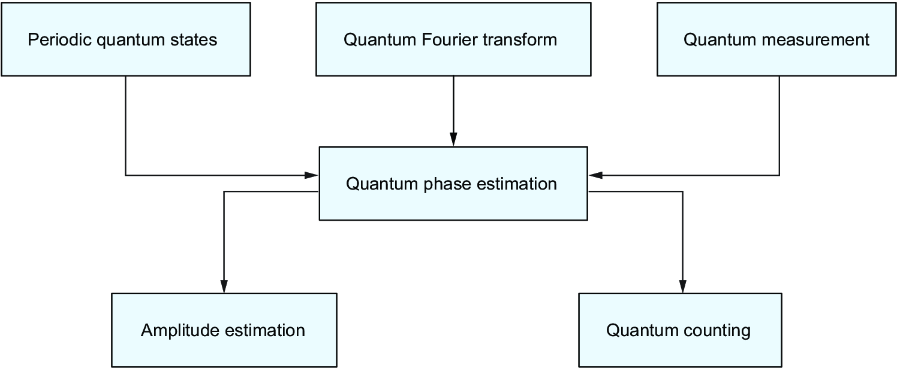
Use the dependency diagram to navigate the relationship between periodic states, frequency estimation, quantum phase estimation, and amplitude-estimation applications. section 9.0
